
Two arbitration decisions show that the same federal law can produce opposite outcomes depending on when the harassment occurred. California’s PAGA regulations are moving forward largely as written. And the state’s civil rights agency has refreshed its guidance on disability accommodations.
It’s been a busy few weeks in California employment law, with two important arbitration decisions, a status update on the state’s forthcoming PAGA regulations, and fresh guidance on disability accommodations.
As always, Sherman Law Corporation is here to help you make sense of it. Here’s what happened and what it means for you, whether you’re an employee dealing with a workplace problem or a business trying to stay ahead of your obligations.
When Sexual Orientation Harassment Voids an Arbitration Agreement
A California appeals court just confirmed something important: harassment based on sexual orientation counts as sexual harassment under California’s anti-discrimination law, known as FEHA. In Decloedt v. Radnet Management, Inc., an employee said a coworker and supervisor repeatedly harassed him because of his sexual orientation, including threats and physical aggression. He had signed an arbitration agreement when he was hired, which normally would push his case out of court and into private arbitration. But because his claim qualified as sexual harassment, the court said it falls under a federal law called the EFAA (the Ending Forced Arbitration of Sexual Assault and Sexual Harassment Act), which lets people bring these claims in court even if they signed an arbitration agreement.
For employees, this is a meaningful protection. If you’re facing harassment tied to your sexual orientation, this ruling means an arbitration agreement you signed may not be able to keep your case out of the courtroom. For employers, it’s a reminder that arbitration agreements have real limits when sexual harassment, including orientation-based harassment, is involved.
For more on how this decision fits into the broader line of California EFAA cases, see our post on California EFAA arbitration and what Doe v. Second Street Corp. established.
But Timing Matters: An Older Harassment Claim Went the Other Way
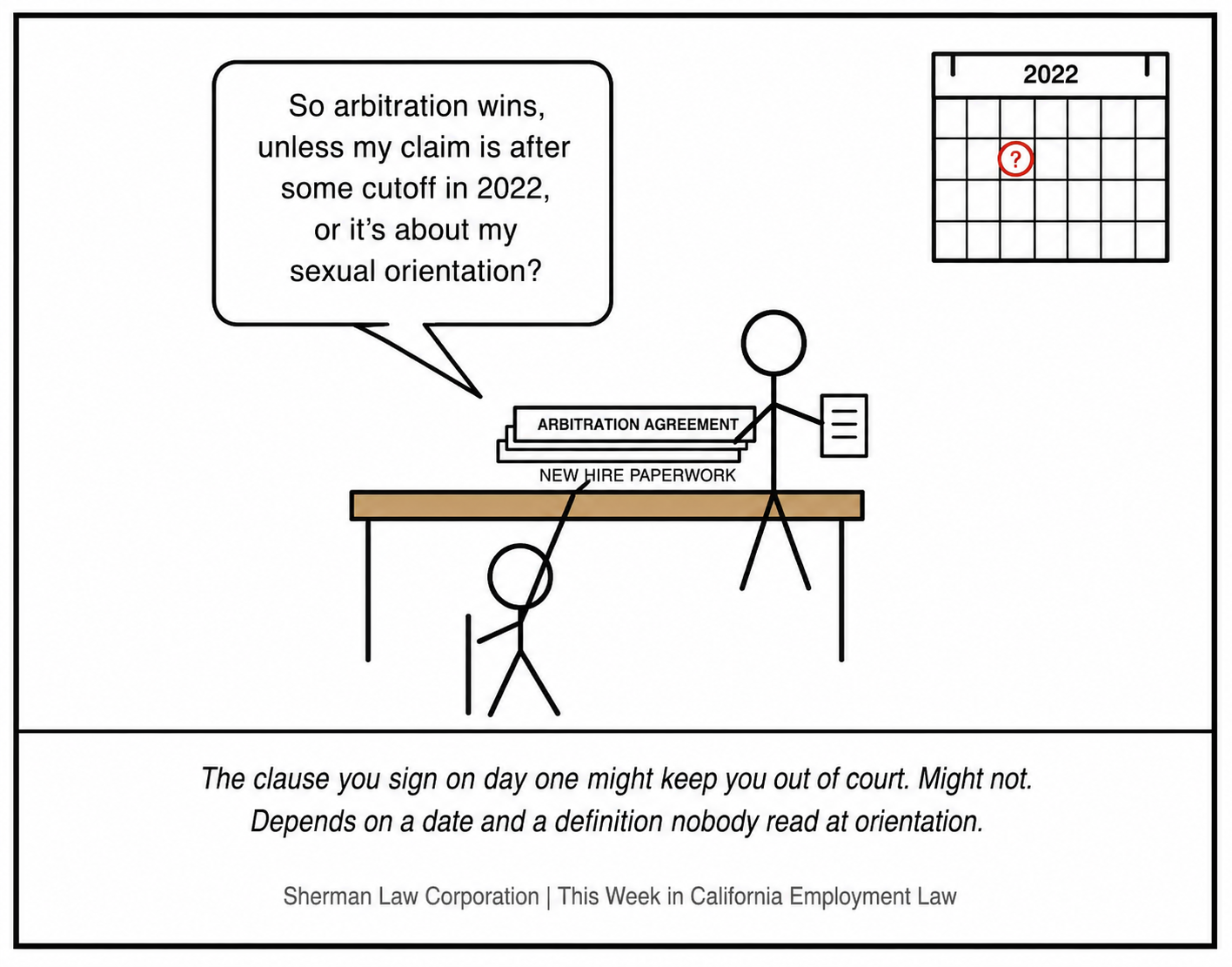
Just weeks earlier, the Ninth Circuit Court of Appeals looked at a similar question in a case involving Netflix and reached the opposite practical result because of when the harassment happened. In Combs v. Netflix, Inc., the employee’s harassment allegations went back to 2017, and the dispute (the disagreement between the employee and employer) had already taken shape before the EFAA became law on March 3, 2022. The court held that the EFAA only protects claims that arose on or after that date, so this employee’s case was sent to arbitration after all.
Put simply: these two cases show that the same law can produce very different outcomes depending on timing and the type of claim. A sexual orientation harassment claim today can keep you out of arbitration, like in the Decloedt case. But if the harassment and your dispute with your employer both took shape before March 2022, arbitration may still apply, even in a similar type of case, as the Netflix decision shows. If you’re unsure whether your situation could go either way, this is exactly the kind of question worth asking an employment attorney early.
PAGA Regulations Are Coming, and the State Isn’t Backing Down
California’s Labor and Workforce Development Agency has been working on new regulations for PAGA, the law that lets employees sue on behalf of themselves and other workers for labor code violations. The proposed rules were released back in February, went through public comment that closed in March, and had a hearing in April. Last week, at a major wage and hour conference in Pasadena, a state official publicly defended the proposed regulations, signaling the agency plans to move forward largely as written. No final rule has been issued yet, but this is a strong signal that change is coming.
For employers, this is a good moment to start reviewing wage and hour practices before the rules are finalized. For employees, it’s worth knowing that the process for bringing these claims may look somewhat different once the regulations are adopted. We’ll keep you posted as soon as anything becomes final.
Updated Guidance on Disability Accommodations
The California Civil Rights Department released an updated fact sheet on disability accommodations at work. It doesn’t create brand new legal duties, but it’s a helpful refresher on existing ones: employers must engage in a timely, good-faith conversation with an employee about possible accommodations, called the interactive process. An employee doesn’t need to use any special legal language, or even put the request in writing, to trigger that process. And employers can’t ask for more medical information than they’re legally entitled to.
The update also newly addresses accommodations for employees, or their family members, who are victims of certain acts of violence, and it reminds employers that demographic data collected for pay reporting purposes needs to be stored separately from personnel files. If you’re an employee who has requested an accommodation and felt brushed off, or an employer wanting to make sure your process is airtight, this guidance is worth a look.
Have a California employment law question? Talk to Sherman Law Corporation
Whether you’re an employee or an employer, if you have a workplace issue you wish to discuss, do not wait for the next development to act.
At Sherman Law Corporation, Lisa Sherman works directly with every client, telling them exactly where they stand, even when that answer is complicated. Contact our office at (323) 488-2087 or at lisa@sherm-law.com.
 This post is attorney advertising and is intended for general informational purposes only. It does not constitute legal advice and does not create an attorney-client relationship.
What do these decisions mean for you?
1. Does the EFAA apply to harassment based on sexual orientation?
Yes, after Decloedt v. Radnet Management. The court held that sexual orientation harassment is a form of harassment “because of sex” under FEHA, which means it qualifies as a sexual harassment dispute under the EFAA. If your case involves this type of harassment and it arose on or after March 3, 2022, an arbitration agreement may not be able to keep your case out of court. Contact our office if you are unsure whether the EFAA applies to your situation.
2. How does timing affect whether the EFAA applies to my claim?
The EFAA only covers disputes that arose on or after March 3, 2022. As Combs v. Netflix shows, if the harassment and the dispute between you and your employer both took shape before that date, you may still be subject to arbitration even if your claim involves sexual harassment. Timing is fact-specific and often the most important question to get right early. Speak with an employment attorney before assuming the EFAA does or does not apply to you.
3. What is PAGA and why should I care about the new regulations?
PAGA, the Private Attorneys General Act, allows employees to bring claims on behalf of themselves and other workers for violations of the California Labor Code. The new regulations being developed by the state will affect how those claims are filed and processed. For employers, now is the time to audit your wage and hour practices before the rules take effect. For employees, the process for bringing a PAGA claim may change once the regulations are finalized. We will cover this in detail once a final rule is issued.
4. What is the interactive process for disability accommodations?
The interactive process is the good-faith conversation an employer and employee are legally required to have when an employee requests a disability accommodation. Under California law, an employer cannot simply ignore or deny a request. They must engage. An employee does not need to use formal legal language or submit a written request to trigger this obligation. If you feel your employer has not engaged properly, that may itself be a violation. Our counseling practice works with both employees and employers on exactly these situations.
5. I signed an arbitration agreement. Can it still be challenged?
It depends on what your claims are and when the relevant conduct occurred. After the line of cases discussed in this post, arbitration agreements have real and clearly defined limits in sexual harassment cases. A well-drafted agreement may still hold up in other types of disputes. Our employment litigation team can review your situation and tell you where you stand.