
A restraining order can’t be signed away, even with a broad separation agreement. California courts also clarified this week that harassment based on sexual orientation can block arbitration under the EFAA and that the timing of your internal complaints determines whether that protection applies to you at all.
It was a busy week for California employment law, with two new Court of Appeal decisions, a notable Ninth Circuit ruling, and a helpful new resource from the state’s civil rights agency. As a California employment attorney at Sherman Law Corporation, below I break down what happened and what it actually means if you’re an employee or an employer trying to navigate these issues in real life.”
Harassment Based on Sexual Orientation Can Now Keep You Out of Arbitration
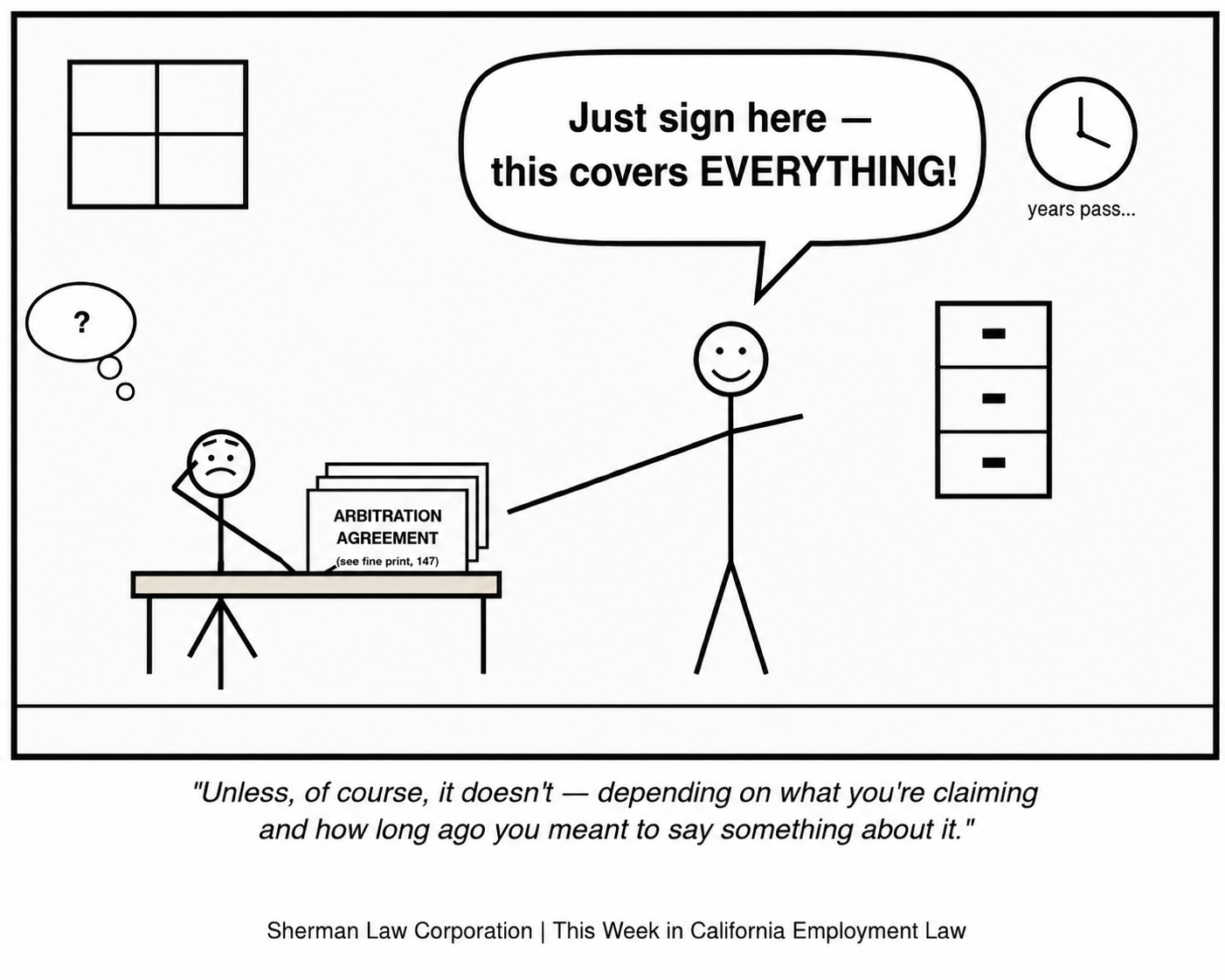
Many California employees sign arbitration agreements when they’re hired, often without much thought about what they’re giving up. Those agreements usually mean that if a dispute comes up later, it has to be resolved by a private arbitrator instead of in court. But there’s an important exception for sexual harassment claims, thanks to a 2021 federal law called the EFAA (short for the Ending Forced Arbitration of Sexual Assault and Sexual Harassment Act).
This week, the California Court of Appeal ruled in Decloedt v. Radnet Management, Inc. that harassment based on someone’s sexual orientation counts as “sexual harassment” for purposes of that law. The case involved an employee who said a coworker harassed him over his sexual orientation, including anti-gay comments and physical aggression. His employer tried to force the case into arbitration, but the court said no because the harassment allegations qualified as sexual harassment under California’s FEHA law and the EFAA, so the whole case gets to stay in court.
If you’re an employee who has experienced harassment tied to your sexual orientation, this decision gives you a stronger argument to keep your case in front of a judge and jury rather than a private arbitrator, even if you signed an arbitration agreement. If you’re an employer, it’s a good reminder that arbitration clauses have real limits when sexual harassment is alleged and that those limits now clearly extend to sexual orientation harassment.
When Does the Clock Start on a Harassment Claim? The Ninth Circuit Weighs In
The same week brought a second ruling on that same 2021 law, this time from the Ninth Circuit Court of Appeals, addressing a different question: when does a dispute actually “arise” for purposes of deciding whether the EFAA applies at all?
In Combs v. Netflix, Inc., an employee alleged she had complained repeatedly between 2017 and 2021 about a sexually charged workplace culture and that she was ultimately fired in retaliation. Because the EFAA only applies to disputes arising on or after March 3, 2022, the timing mattered a great deal. The Ninth Circuit held that a dispute “arises” when an employee raises an objection, and the employer pushes back, not simply when someone files a formal complaint with an agency or a court. Applying that standard, the court found this dispute arose back in December 2021, before the law took effect, so arbitration was properly ordered. Taken together with the Decloedt decision, this is an important week for understanding the EFAA’s real-world limits. For employees, it means the timing of your internal complaints matters just as much as when you eventually file a claim. If your complaints and your employer’s response happened before March 2022, an arbitration agreement may still apply even if you didn’t file a lawsuit until much later. For employers, this ruling gives you a real argument for compelling arbitration in older disputes that were only recently formalized into a legal claim.
For a deeper look at how California courts have applied the EFAA’s timing rules to continuing violations, see Doe v. Second Street Corp. (2024) 105 Cal.App.5th 552, a published California Court of Appeal decision addressing precisely this issue.
A Separation Agreement Can’t Sign Away an Employer’s Right to Seek a Restraining Order
Employers sometimes settle disputes with departing employees using a separation agreement that includes a broad release of “any and all claims”. This week’s decision in Adelanto Elementary School District v. Krause addresses just how far that kind of release can go.
The school district had gotten a workplace violence restraining order against its former superintendent on behalf of
three employees, based on a pattern of intimidating conduct. He argued the district had already given up its right to seek that kind of order in his separation agreement. The Court of Appeal disagreed, holding that an employer’s right to seek a workplace violence restraining order to protect its employees cannot be waived, no matter how broad the release language is. The court did trim back one part of the order that raised First Amendment concerns given his current role as an elected official and shortened its duration to match the three-year maximum allowed by law.
The takeaway for employers is simple but important: a general release in a separation agreement will not stop you from seeking protection for your employees later if a genuine safety threat develops. For employees, it’s reassuring to know that your employer’s ability to protect you from workplace violence doesn’t just disappear because of paperwork signed on someone’s way out the door.
A Helpful New Resource on Disability Accommodations
Outside the courts, California’s Civil Rights Department released a new fact sheet this week on disability accommodation rights at work. It walks through an employee’s right to request a reasonable accommodation, the limits on what medical documentation an employer can demand (employers cannot go fishing for a specific diagnosis or a full medical file when the need for accommodation isn’t in question), the interactive process employers and employees are supposed to go through together, and accommodations related to safety after a qualifying act of violence.
The CRD describes this as a reminder of existing rules rather than anything new, but it’s a genuinely useful, plain language resource. Employees can use it to understand what they’re entitled to ask for, and employers can use it as a practical checklist to make sure their accommodation process is on solid footing.
Have a Workplace Issue?
Whether you’re an employee or an employer, if you have a workplace issue you wish to discuss, contact Sherman Law Corporation at lisa@sherm-law.com or call 323-488-2087.
 This post is attorney advertising and is intended for general informational purposes only. It does not constitute legal advice and does not create an attorney-client relationship. Please consult an attorney about your specific situation.
Questions About How These Decisions Impact You
1. Does California’s FEHA protect employees from harassment based on sexual orientation?
Yes. Under California’s Fair Employment and Housing Act (FEHA), harassment based on sexual orientation is unlawful. The recent decision in Decloedt v. Radnet Management, Inc. confirmed that such harassment also qualifies as “sexual harassment” for purposes of the EFAA, meaning employees can keep their case in court even if they signed an arbitration agreement.
2. What is the EFAA, and how does it protect employees?
The Ending Forced Arbitration of Sexual Assault and Sexual Harassment Act (EFAA) is a 2021 federal law that prevents employers from forcing employees to resolve sexual harassment and sexual assault claims through private arbitration. At the employee’s election, these cases can be heard in court instead. For more on how California courts have applied this law, see Doe v. Second Street Corp. (2024) 105 Cal.App.5th 552.
3. When does the EFAA’s clock start — and why does timing matter?
The EFAA only applies to disputes that arise on or after March 3, 2022. In Combs v. Netflix, Inc., the Ninth Circuit held that a dispute “arises” when an employee raises an objection and the employer pushes back, not when a formal complaint is filed. This means your internal complaints and your employer’s response to them are critical in determining whether the EFAA applies to your case.
4. Can an employer still seek a workplace violence restraining order after signing a separation agreement?
Yes. The Court of Appeal in Adelanto Elementary School District v. Krause confirmed that an employer’s right to seek a workplace violence restraining order to protect its employees cannot be waived, even by a broad “any and all claims” release in a separation agreement. Employee safety cannot be signed away.
5. What medical documentation can an employer request for a disability accommodation?
According to the California Civil Rights Department’s new fact sheet, employers cannot demand a specific diagnosis or a full medical file when the need for accommodation is not in question. The employer and employee are required to engage in a good-faith interactive process together to determine the appropriate accommodation.
6. How can Sherman Law Corporation help with employment law issues?
Whether you are an employee whose rights have been violated or an employer trying to stay compliant with California’s rapidly changing employment laws, Lisa Sherman provides experienced, strategic counsel. Contact us at lisa@sherm-law.com or call 323-488-2087.