
Two Ninth Circuit decisions and a fee award in a high-profile Hollywood case all landed within weeks of each other. One confirms that the EFAA can pull a case out of arbitration even after arbitration has already started. Another draws a line between sincere religious belief and personal health preference. And the Blake Lively fee award is a useful reality check on what courts actually award in harassment cases versus what gets requested.
If your arbitration agreement, your religious accommodation policy, or your understanding of what harassment litigation actually costs is based on assumptions rather than current law, this week changed the picture on all three. At Sherman Law Corporation, our employment litigation practice handles exactly these situations.
It has been a busy few weeks in employment law, with two Ninth Circuit decisions and a major fee ruling in a high profile Hollywood case all landing within weeks of each other. Each one touches something I see clients wrestle with regularly: arbitration agreements, religious accommodation requests, and what happens financially after a harassment case actually gets litigated. Here is what happened and what it means for you, whether you are running a business or showing up to work every day trying to do your job.
Arbitration Agreements Have a New Escape Hatch for Sex Discrimination Claims
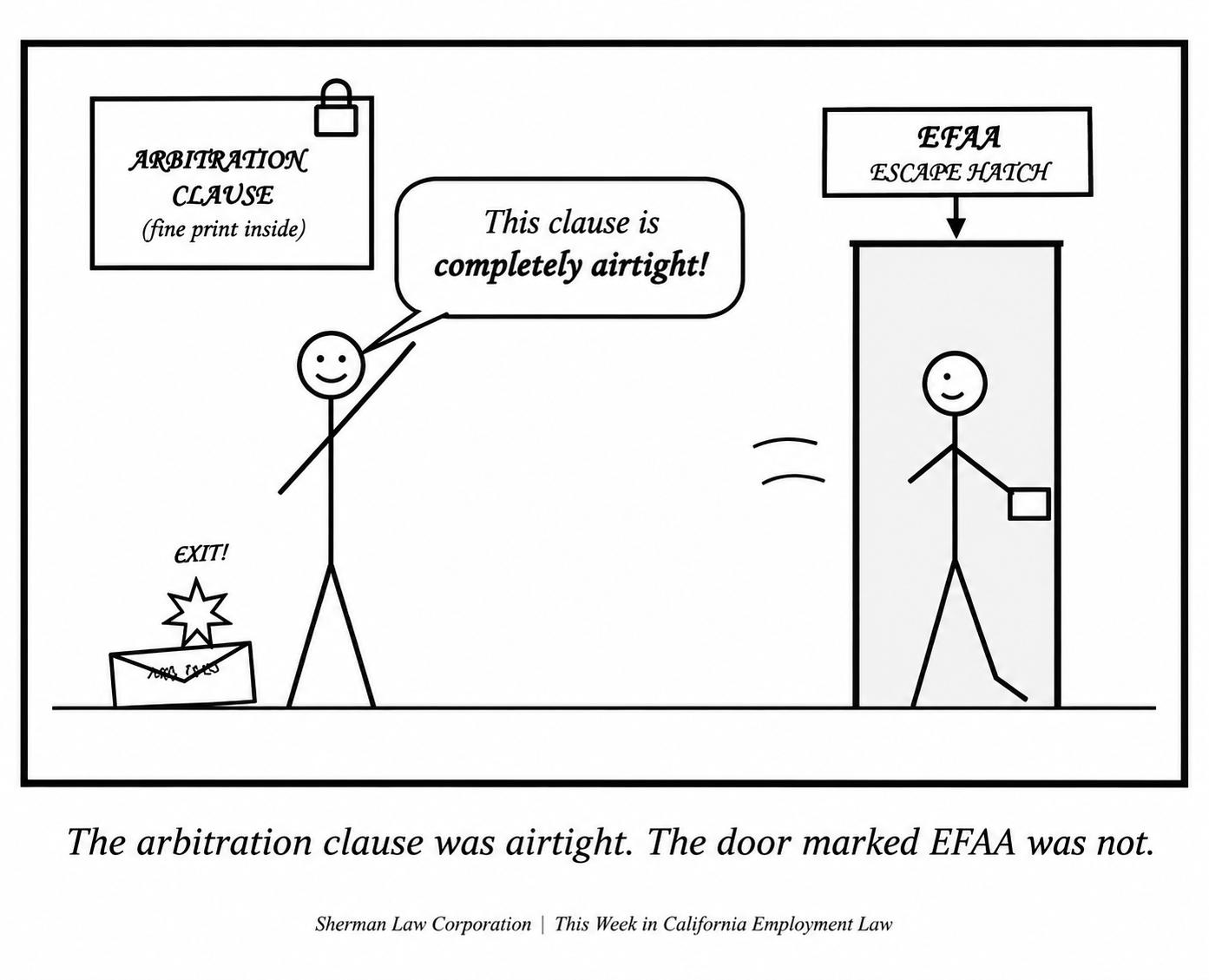
In Ding v. Structure Therapeutics, Inc., decided by the Ninth Circuit on August 19, 2026, a former Chief Financial Officer had been pushed out after asking for workplace accommodations connected to a domestic violence incident. She first filed an arbitration demand claiming national origin discrimination and mistreatment related to her status as a domestic violence victim. But during arbitration discovery, she uncovered evidence suggesting the real motive behind her treatment was her sex, not her national origin. She withdrew from arbitration and filed suit in court instead, adding sex discrimination and hostile work environment claims. The employer had also been late paying its arbitration fees, which is its own separate problem under California law.
The Ninth Circuit sided with the employee, holding that a federal law called the Ending Forced Arbitration of Sexual Assault and Sexual Harassment Act lets an employee move a case out of arbitration and into court once she has a plausible sex discrimination or harassment claim, even if that claim only comes into focus after arbitration has already started. The court did note that an employee who sits on this right too long could potentially lose it through delay, but that did not happen here.
For employees, this is meaningful news. Many of you signed arbitration agreements when you were hired, often without much choice in the matter. This decision confirms that if facts come out during the arbitration process itself suggesting sex discrimination or harassment, you are not necessarily stuck in that private, closed door process. You may be able to bring that claim to court instead. For employers, this is a reminder that arbitration agreements are not an ironclad shield once sex based claims enter the picture, and that keeping current on arbitration fee deadlines matters more than ever.
Religious Accommodation Requests: Courts Will Look at What You Actually Believe, Not Just the Words You Use
In Ledezma v. Optum Services, Inc., decided August 13, 2026, by a divided Ninth Circuit panel, a pharmacist was terminated after refusing her employer’s mandatory COVID-19 vaccination policy. She asked for a religious exemption, describing her Catholic faith and citing scripture, arguing her body was a “temple of the Holy Spirit” that she was religiously obligated to keep free of foreign substances. She sued under California’s Fair Employment and Housing Act for religious discrimination.
The majority sided with the employer, finding that her objection was ultimately about her personal views on vaccine safety and holistic health, not a sincerely held religious belief. The court’s key point was that using religious language or quoting scripture does not, by itself, turn a secular preference into something legally protected. One judge dissented, arguing the majority went too far in scrutinizing the theological basis of her belief.
What this means practically is that employers evaluating a religious accommodation request need to look at the substance of the belief, not just whether religious vocabulary was used to describe it. Employees seeking accommodations should know that courts will examine whether an objection is genuinely rooted in religious conviction versus personal health preference dressed up in religious terms. This case does not mean religious accommodation requests are disfavored. It means the label alone is not enough. Both sides benefit from taking a thoughtful, fact specific approach rather than assuming a request must be automatically granted or automatically denied.
The Blake Lively Fee Award: A Reality Check on What Harassment Cases Actually Recover
Lively v. Wayfarer Studios LLC is the well-known case in which actress Blake Lively sued Wayfarer Studios and Justin Baldoni for sexual harassment and retaliation during production of the film “It Ends With Us.” California’s Fair Employment and Housing Act applied because of the California connections to the underlying conduct and employment relationship. Baldoni had also brought defamation related counterclaims against Lively, and the court dismissed those.
Because Lively won on that defamation counterclaim, she was entitled to recover her reasonable attorneys’ fees and costs under a California fee shifting statute. Her legal team asked for a little over eight million dollars, roughly seven and a half million in fees plus more than half a million in costs. In an order entered in late August 2026, the judge instead awarded her about $407,451.75 total, benchmarking the number partly against a co-defendant’s own, more modest fee request in related litigation.
This is not a new liability ruling, and it does not change the underlying harassment and retaliation claims in the case. What it offers is something both employees and employers in harassment and retaliation cases often ask me about directly: what does a court actually award in fees, compared to what a winning party requests. Here, the gap between the request and the award was enormous. If you are an employee weighing whether to pursue a claim, or a business trying to understand your realistic exposure, this case is a useful data point on how far courts will actually go when it comes to fee shifting, even in a high profile matter with well resourced lawyers on both sides.
Have a Workplace Issue?
Whether you’re an employee or an employer, if you have a workplace issue you wish to discuss, contact Sherman Law Corporation at lisa@sherm-law.com or call 323-488-2087.
 This blog post is attorney advertising and is provided for general informational purposes only. It does not constitute legal advice and does not create an attorney-client relationship. Every situation is different, and you should consult with an attorney about the specific facts of your case.
What Do These Decisions Mean for You?
1. I am already in arbitration. Can I still use the EFAA to move my case to court if I discover sex discrimination evidence?
Possibly yes, after Ding v. Structure Therapeutics. The Ninth Circuit held that the EFAA can be invoked even after arbitration has started, as long as you do not sit on the right too long once you have the evidence. Timing matters and is fact-specific. If you have uncovered evidence of sex-based discrimination or harassment during arbitration, contact our office immediately to understand your options before you lose the right to act.
2. My employer was late paying arbitration fees. Does that affect the agreement?
Yes, potentially significantly. California law imposes strict consequences for employers who fail to pay arbitration fees on time, including the employee’s right to withdraw from arbitration and proceed in court instead. This was a separate issue in the Ding case and one that courts take seriously. See our post on two new arbitration rulings affecting contract scope and fairness for more on how courts scrutinize arbitration agreements.
3. An employee submitted a religious accommodation request citing scripture. Do I have to grant it?
Not automatically. After Ledezma, courts will look at the substance of the belief, like whether it is genuinely rooted in religious conviction, not just whether religious language was used. You must engage in a genuine, good-faith evaluation of the request rather than a rubber stamp in either direction. Our counseling practice can help you structure that evaluation correctly and document it properly.
4. I submitted a religious accommodation request and was denied. Do I have a claim?
It depends on the substance of your belief and how your employer handled the request. If your objection was genuinely rooted in religious conviction and your employer failed to engage in a good-faith individualized assessment, you may have a claim. The Ledezma case shows that courts will scrutinize both sides carefully. Contact our employee representation team to assess your specific situation.
5. What is fee shifting, and how does the Blake Lively case affect what I might recover?
Fee shifting is a California law mechanism that lets a winning party recover their attorneys’ fees and costs from the other side in certain employment cases. The Blake Lively ruling is a good real-world example of how that plays out in practice. Her team asked for over $8 million. The judge awarded $407,451.75. That is roughly 5 cents on the dollar. Courts benchmark what is reasonable, not what was billed, and even well-resourced legal teams with strong wins can see their requests cut dramatically.
6. How can Sherman Law Corporation help with any of these issues?
Whether you are an employee navigating an arbitration agreement, a religious accommodation dispute, or a harassment claim, or an employer trying to understand your exposure after these rulings, Sherman Law Corporation works directly with you to give you a clear picture of where you stand. Contact Lisa at lisa@sherm-law.com or call 323-488-2087.
Have a California Employment Law Question? Talk to Sherman Law Corporation
Whether you’re an employee or an employer, if you have a workplace issue you wish to discuss, do not wait for the next development to act. At Sherman Law Corporation, Lisa Sherman works directly with every client, telling you exactly where you stand, even when that answer is complicated. Contact our office at lisa@sherm-law.com or call 323-488-2087.