
California Governor Newsom has until September 30, 2026, to act on nearly two dozen employment bills, including landmark AI workplace rules, new FEHA protections for menopause, and expanded bereavement leave. Sherman Law Corporation is tracking all of it. Here is what employees and employers need to know before the deadline hits.
If you blinked, you might have missed it. Governor Newsom has a stack of employment bills sitting on his desk, and under California law, he has until September 30, 2026, to sign them, veto them, or let them become law automatically without his signature. That means in the next week or so, California could see some real changes to workplace rules, from how AI can be used to discipline employees to how the law defines sex discrimination. Nothing here is final law yet, but it is close, and it is worth understanding now so you are not caught off guard.
Here is what employees and employers alike should be watching.
AI Is Making More Workplace Decisions. New Bills Would Rein It In.
Two bills awaiting the Governor’s signature take direct aim at how employers use artificial intelligence to manage their workforce, and together they represent one of the more significant shifts on the horizon.
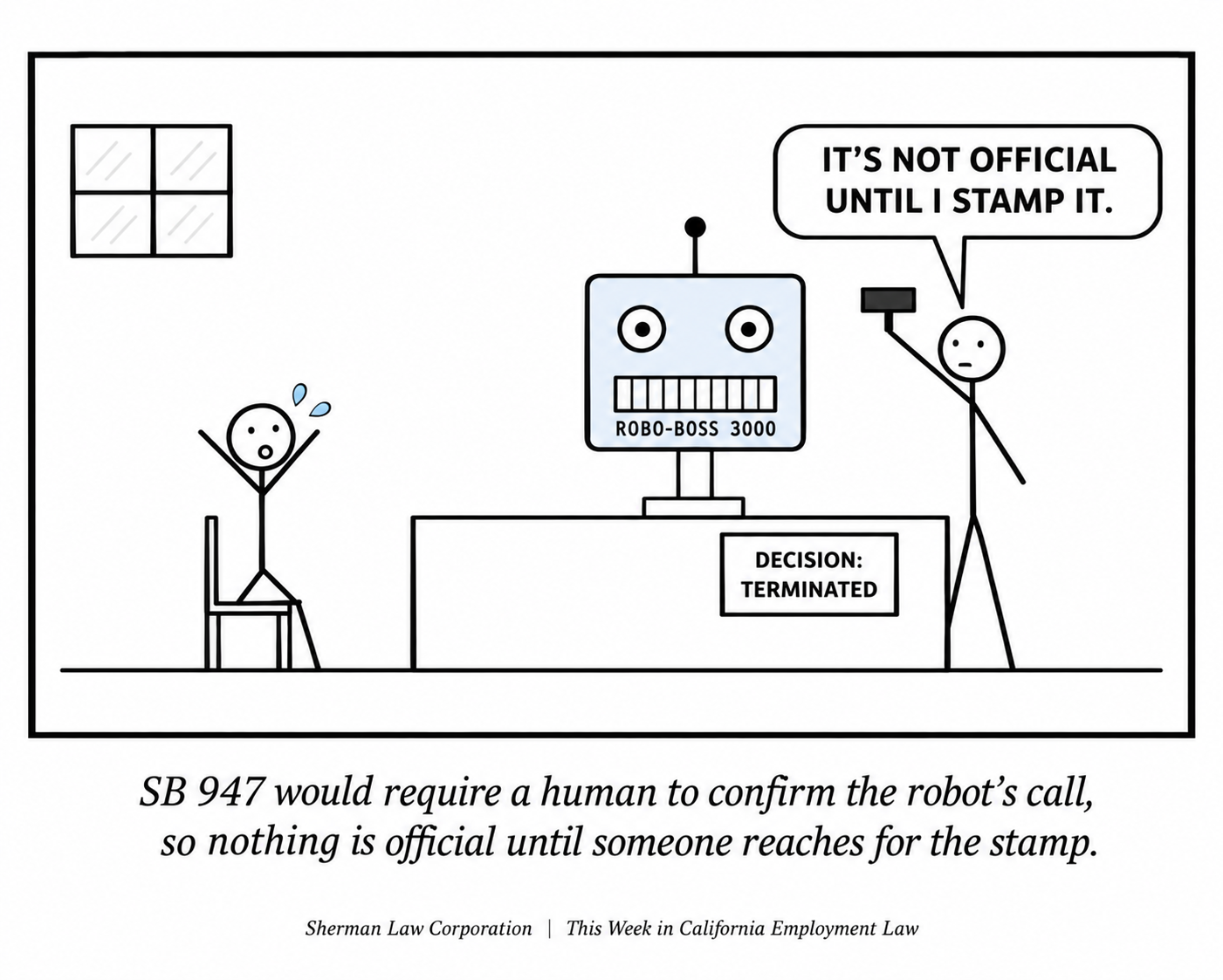
The first, nicknamed the “No Robo Bosses Act,” would require a human being to actually review and confirm any decision made by an automated or AI system before an employer can discipline or fire an employee (full text of SB 947, the No Robo Bosses Act). In plain terms, no one could be terminated purely because an algorithm flagged them. A real person would have to check the AI’s work first. If signed, this would take effect July 1, 2027, giving employers time to build that human review step into their processes.
The second bill would ban a different kind of AI use altogether: workplace surveillance tools that collect neural data or try to read employees’ emotional states (full text of AB 1883). Think devices or software that claim to monitor brain activity or detect mood and stress levels on the job. This bill would prohibit that outright and, importantly, would let an employee sue directly if an employer violates it. For workers, this is a meaningful new protection against increasingly invasive monitoring technology. For employers, it is a clear signal to review any AI-driven monitoring tools now, before they might become illegal overnight.
Menopause Could Become an Explicit Protected Category Under FEHA
Another bill awaiting signature would add perimenopause and menopause to the definition of sex discrimination under California’s Fair Employment and Housing Act, or FEHA (full text of AB 1940). FEHA is the main state law that protects employees from discrimination and harassment at work, and this bill would make clear that treating an employee unfairly because of perimenopause or menopause counts as sex discrimination under that law.
For employees, this means clearer legal footing if you experience mistreatment, denied accommodations, or negative comments tied to menopause symptoms at work. For employers, the bill would also require an updated workplace poster by July 1, 2027, so this is a compliance date worth putting on the calendar now if the bill is signed.
Two More Bills Worth Knowing About
A couple of smaller but still practical bills are also pending. One would update California’s WARN Act, the law requiring advance notice before mass layoffs, so that when a layoff notice is triggered by AI or automation, the notice has to say so (full text of SB 951). The existing 60-day advance notice requirement would stay the same. This gives affected workers more honest information about why they are losing their jobs.
The other would expand California’s bereavement leave law to let employees take leave for the death of a “designated person” of their choosing, not just a traditional family member, limited to one such designation every 12 months (full text of SB 1149). This is a welcome bit of flexibility for the many modern families and close relationships that do not fit neatly into the old definitions.
A Quick Word on Timing
None of the bills above are law yet. They are sitting on the Governor’s desk, and he has until September 30, 2026, to sign or veto each one. If he takes no action by that date, most become law automatically. The Governor has already acted on some other employment-related bills this month, signing several minor measures and vetoing one dealing with a state training program, so he is actively working through this stack. We will report back once the dust settles on the bills that matter most to employees and employers.
Have a Workplace Issue?
Whether you’re an employee or an employer, if you have a workplace issue you wish to discuss, contact Sherman Law Corporation at lisa@sherm-law.com or call 323-488-2087.
 This blog post is attorney advertising and is intended for general informational purposes only. It does not constitute legal advice and does not create an attorney-client relationship.
What Do These Decisions Mean for You?
1. Do any of these bills affect me if I’m not in tech?
Yes. The AI bills are not limited to tech workers. Any employer in any industry using automated tools to flag performance issues, schedule shifts, or manage disciplinary decisions could be covered by SB 947. If your employer uses software that scores your output, tracks your productivity, or generates recommendations about your employment status, this bill is relevant to you.
2. What does the “No Robo Bosses Act” actually require employers to do?
If signed, it would require a human decision-maker to review and confirm any AI-generated recommendation before an employee is disciplined or terminated. The AI can flag the issue, but a real person has to make the call. Employers should start auditing any automated HR tools now to understand where human review is currently missing.
3. Is menopause already protected under California law before AB 1940?
Arguably yes, through the existing definition of sex discrimination and disability accommodations under FEHA, but not explicitly. AB 1940 would remove any ambiguity by naming perimenopause and menopause directly. That matters because explicit protections are easier to enforce and harder to ignore. If you have experienced discrimination or harassment related to menopause symptoms at work, you may already have a claim worth discussing with an attorney.
4. Can an employer be held liable now for AI-driven termination decisions?
Potentially, depending on the circumstances, even before these bills pass. Retaliation and wrongful termination claims in California do not require a new law if underlying facts support an existing claim. These bills would create an additional, clearer standard. If you believe you were terminated based on an automated process with no meaningful human review, contact Sherman Law Corporation to discuss your options.
5. Who counts as a “designated person” under the expanded bereavement leave bill?
The bill lets each employee designate one person of their choosing, with no requirement that the person be a family member. The designation is limited to one person every 12 months. Employers should update their bereavement leave policies to reflect this flexibility if SB 1149 is signed.
6. What should employers do right now to prepare?
Audit your AI and automated decision tools to identify where human review is absent. Review your FEHA and harassment policies to be ready to add menopause as an explicit protected category. Update your bereavement leave policy template. These compliance steps cost little now and can be significant if you are caught unprepared after the September 30 deadline. If you are unsure where to start, speaking with employment counsel before the deadline is the most efficient first step.