
A Ninth Circuit ruling confirms that silence and inaction do not equal an arbitration agreement under California law. California’s PAGA regulations are almost final, with the comment window closing tomorrow. And San Francisco is cutting the parental leave waiting period in half for qualifying employees.
If your company sent arbitration agreements by email and assumed silence meant acceptance, this week’s Ninth Circuit decision is a wake-up call. And if you have any employees working in San Francisco, the new parental leave changes have deadlines you need to put in your calendar now. At Sherman Law Corporation, our employment litigation and counseling practice helps employers and employees understand exactly what these changes mean before they become problems. Here is what happened this week and what it means for you.
This was a quieter week on the discrimination front, but a federal appeals court handed down an important ruling on arbitration agreements, California regulators are close to finalizing new rules for PAGA lawsuits, and San Francisco just made it easier for more workers to qualify for paid parental leave pay. Here is what you need to know.
Ninth Circuit: An Email and Your Silence Do Not Equal an Arbitration Agreement
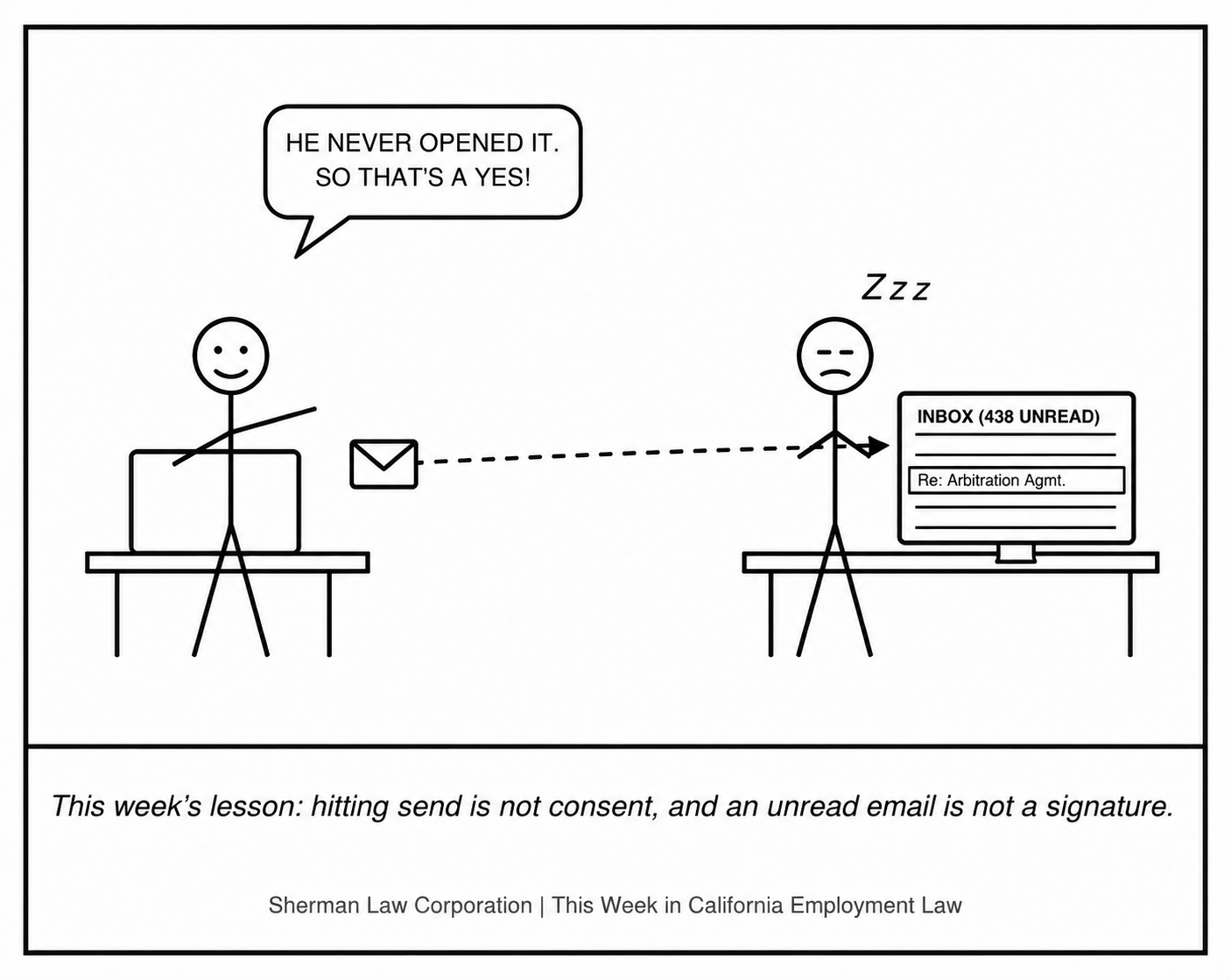
In Rickes v. Thermo Fisher Scientific, Inc., the Ninth Circuit Court of Appeals ruled that an employer cannot force an employee into arbitration just because it emailed the employee an arbitration agreement and the employee did not opt out. Thermo Fisher had sent its arbitration agreement to an employee’s work email four times, and its policy was that if the employee did not opt out within 45 days and kept working, that counted as agreeing to arbitrate all future disputes. The problem was that Thermo Fisher had no proof that the employee ever opened those emails or clicked on anything, and the employee said he did not remember getting them.
The court said that is not good enough. Under California law, agreeing to a contract takes more than staying silent. Someone has to actually do something, like clicking a button, checking a box, or signing, to show they agreed. Simply not opting out of an email you may never have seen does not count. This builds on the same principle behind the rule that California arbitration agreements not signed by the employer are also unenforceable. In both cases, courts require genuine mutual assent, not assumed consent.
For employees, this is good news if you are ever told you cannot sue your employer in court because you “agreed” to arbitration through some email you do not recall seeing. For employers, this is a wake-up call. If your company rolled out arbitration agreements by email with a passive opt-out period and no way to confirm employees actually engaged with the terms, that agreement may not hold up. Now is a good time to review how your arbitration agreements were actually presented and accepted.
PAGA Regulations Are Close to Final, and the Comment Window Is Closing
California’s Labor and Workforce Development Agency has released modified proposed PAGA regulations that will govern how PAGA lawsuits (the law that lets employees sue on behalf of the state for Labor Code violations) get started and processed going forward. The rules touch nearly every step, from how a claim gets filed, to new scrutiny on attorneys who file large numbers of these notices, to how other workers get notified about settlements.
The public comment period closes on August 18, 2026, which is tomorrow. If your business or your legal team has views on how these rules should work, this is essentially the last call to weigh in before they are finalized. Once these regulations take effect, they will shape how PAGA claims are brought and defended for both workers and employers, so it is worth paying attention to the final version once it is published.
San Francisco Shortens the Wait for Paid Parental Leave Pay
San Francisco Ordinance No. 162-26, signed by Mayor Daniel Lurie on August 7, 2026, shortens how long an employee has to work for a company before qualifying for supplemental paid parental leave pay under the City’s Paid Parental Leave Ordinance. The minimum tenure requirement drops from 180 days to 90 days, bringing it in line with the City’s paid sick leave rules. For broader context on California’s parental leave framework, see our post on unpaid job-protected parental leave and small businesses in California.
This change is staggered based on employer size. It kicks in for leave starting on or after January 1, 2027, for employers with 100 or more employees and January 1, 2028, for employers with 20 to 99 employees. Nothing changes yet in 2026 itself, and no one becomes newly eligible this year.
Here is the detail that catches people off guard: this applies based on your company’s total employee count everywhere, not just how many people you employ in San Francisco. So if your business has 20 or more employees total and even one of them works in San Francisco, you need to pay attention to this ordinance and update your parental leave policies before the 2027 and 2028 deadlines. Everything else about the program, including the eight-week pay period and the annual pay cap, stays the same for now.
Have a Workplace Issue?
Whether you’re an employee or an employer, if you have a workplace issue you wish to discuss, do not wait for the next development to act. At Sherman Law Corporation, Lisa Sherman will work directly with you to shed light on exactly where you stand, even when that answer is complicated. Contact our office at lisa@sherm-law.com or call 323-488-2087.
 This post is attorney advertising and is intended for general informational purposes only. It does not constitute legal advice and does not create an attorney-client relationship. For advice about your specific situation, please consult a licensed attorney.
What Do These Decisions Mean for You?
1. My company sent arbitration agreements by email with a passive opt-out. Are those enforceable?
Possibly not, after Rickes v. Thermo Fisher. California courts require proof that an employee actually engaged with and accepted an arbitration agreement, not just that they stayed silent or kept working. If your company cannot show that employees opened, read, or affirmatively acknowledged the agreement, you may have a problem. Our employment litigation team can review your rollout process and tell you where you stand.
2. I never saw an arbitration agreement from my employer. Can they still force me into arbitration?
Under Rickes, probably not if the only evidence is that an email was sent to you and you did not opt out. California law requires genuine assent to a contract. Silence and inaction are not enough. If your employer is trying to compel arbitration based on an email you do not recall receiving or engaging with, contact our office to discuss your options.
3. What should employers do now to make their arbitration agreements enforceable?
At minimum, you need a system that confirms employees actually received, opened, and affirmatively acknowledged the agreement, not just that it was sent. A click-through acknowledgment, a wet or electronic signature, or a confirmed read receipt tied to an affirmative action are all stronger than a passive opt-out window. If your current agreements rely on the latter, now is the time to fix it.
4. What are the PAGA regulation changes about, and why should I care?
PAGA, the Private Attorneys General Act, allows employees to sue on behalf of the state and other workers for Labor Code violations. The new proposed regulations govern how those claims get filed and processed, including new rules on attorney filing practices and worker notification in settlements. The comment window closes August 18. Once finalized, these rules will affect how both employers defend and employees bring PAGA claims. We will cover the final rules in detail once published.
5. My business has 25 employees, one of whom works in San Francisco. Does the new parental leave ordinance apply to me?
Yes, if you have 20 or more employees total anywhere and at least one works in San Francisco, you are covered. The tenure requirement drops from 180 to 90 days, with the change effective January 1, 2028, for employers your size. Start reviewing your parental leave policies now so you are not scrambling when the deadline arrives. Our counseling practice can help you update your policies ahead of the deadlines.
6. How can Sherman Law Corporation help with any of these issues?
Whether you need to audit your arbitration rollout process, understand your PAGA exposure, or update your San Francisco parental leave policies, Sherman Law Corporation works directly with employers and employees to give you a clear picture of where you stand. Contact Lisa at lisa@sherm-law.com or call 323-488-2087.