
Two weeks of California employment law in one place. A Court of Appeal decision narrows when employers face strict liability for supervisor harassment, another draws the line on religious accommodations, and a third shows why employees with harassment claims need to raise their rights early. Governor Newsom also wrapped up his action on this year’s employment bills, including a new law restricting AI-driven firing decisions. Sherman Law Corporation handles employment litigation and employee representation for California employees and employers.
It has been a busy two weeks for California employment law. The courts of appeal published several significant decisions, and Governor Newsom wrapped up his action on this year’s crop of employment bills. Here is what employees and employers in California need to know, in plain terms.
When Is a Company Automatically on the Hook for Harassment?
In Doe v. Wells Fargo Bank, the Court of Appeal addressed an important question. When is a company automatically liable if a supervisor harasses an employee? Under California’s Fair Employment and Housing Act, companies face a tougher, strict liability standard when the harasser is the victim’s own supervisor. But in this case, the employee alleged that a colleague who supervised other staff, but not her, sexually assaulted and harassed her on a business trip. Because he was not her supervisor, the court applied a more lenient negligence standard instead, and found that Wells Fargo’s response to her complaint was reasonable. The company won.
For employees, this case is a reminder that not every harasser with a manager title triggers the strictest form of company liability. The key question is whether that person had supervisory authority over you specifically. For employers, it underscores that having a prompt, reasonable process for investigating and responding to harassment complaints matters enormously, especially in cases that fall outside strict liability.
Frankly, I think this holding is unlikely to remain the final word on the subject. Drawing a hard line between a harasser who supervises the victim and one who merely supervises other people in the same workplace sits uneasily with FEHA’s broad remedial purpose, and I would not be surprised to see it revisited, either by a later panel or by the California Supreme Court. Employees and employers alike should watch this one rather than treat it as settled law.
Vaccine Accommodations: When Unpaid Leave Is Enough
In Smith v. Burbank Unified School District, a teacher who refused a COVID-19 vaccine for religious reasons sued the school district after she was placed on unpaid leave rather than given a different accommodation. The Court of Appeal sided with the district, finding that unpaid leave was the only reasonable accommodation available for a classroom teacher in her position, since masking and weekly testing were not offered to any in-person instructional staff.
This case is a good illustration of how far the duty to accommodate goes, and where it ends. Employers do not have to offer an employee’s preferred accommodation. They have to offer a reasonable one, and if no lesser option is actually available to anyone in that role, unpaid leave can satisfy the obligation. Employees weighing a religious or medical accommodation request should understand that the law requires reasonableness, not a guarantee of staying on the job with pay.
Arbitration and the Sexual Harassment Carve-Out: Timing Matters
A federal law called the Ending Forced Arbitration of Sexual Assault and Sexual Harassment Act (“EFAA”) gives people with sexual harassment claims the right to go to court instead of arbitration, even if they signed an arbitration agreement. I have a published decision on the applicability of the EFAA. In Chin v. DoorDash, the Court of Appeal addressed what happens when someone tries to use that right too late.
The plaintiff fought to stay out of arbitration in court, without telling the court he actually had a known sexual harassment claim. He lost that fight and was sent to arbitration. Only then did he add a harassment claim and try to invoke the federal law to pull his entire case back into court. The Court of Appeal said no. Because he strategically withheld the harassment claim and did not raise his rights under the law when arbitrability was first being litigated, he gave up that protection, both for the claim he had hidden and for the rest of his case.
The lesson here cuts both ways. For employees with a harassment claim, this case shows that the right to avoid arbitration needs to be raised early and honestly, not held in reserve as a strategic trump card. For employers, it confirms that the courts will hold plaintiffs to real consequences for gamesmanship around this law.
Sacramento Acts: Three New Laws Worth Knowing About
Governor Newsom signed or vetoed the bulk of this year’s employment bills between September 18 and September 30. Three developments stand out.
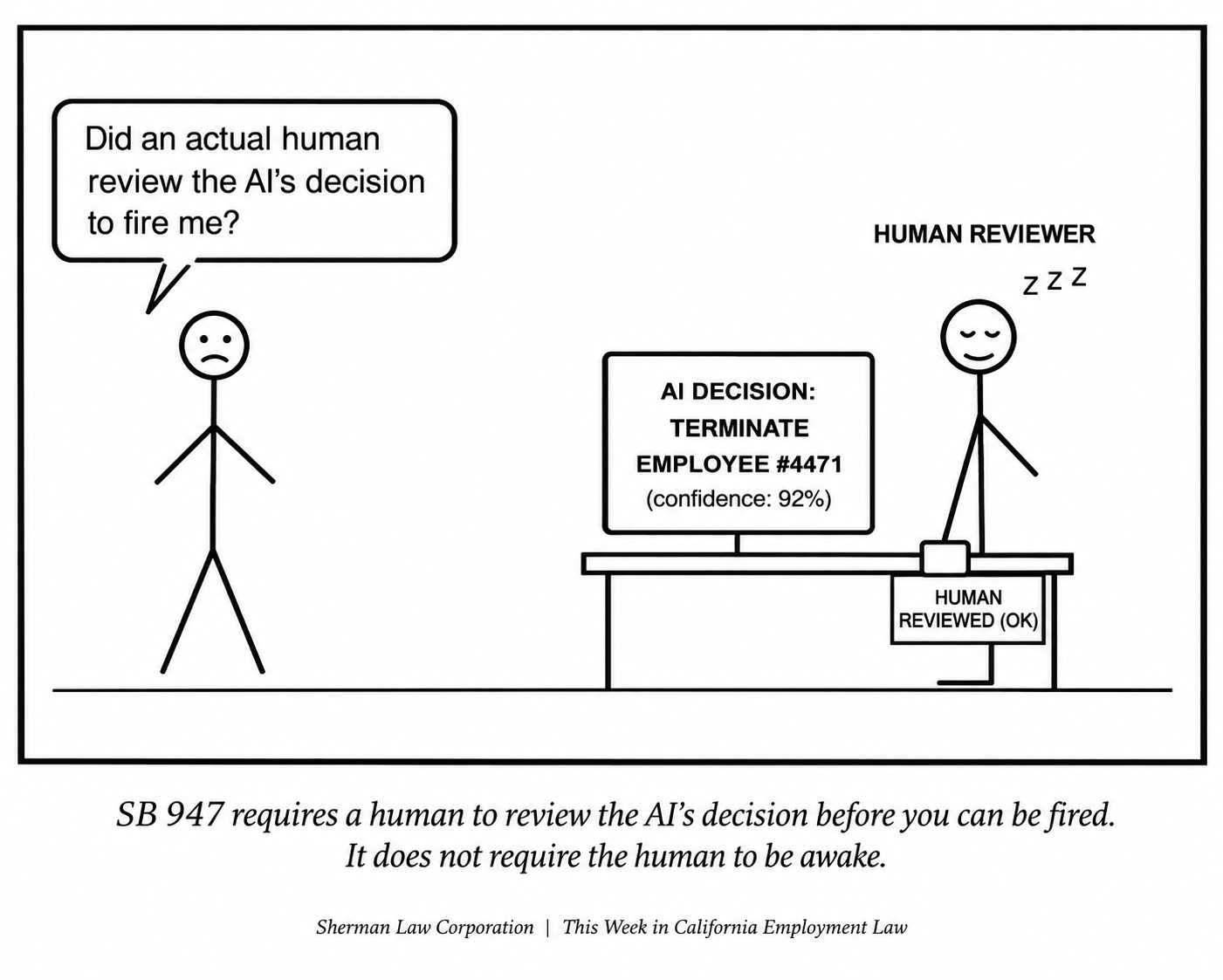
First, a new law restricting AI-driven firing decisions will take effect July 1, 2027. It prohibits employers from relying solely on an automated system, such as an AI tool, to make a discipline or termination decision without a human reviewing it first. Employers who use automated tools in performance management should start planning now to build human review into those processes.
Second, a new law increases the penalty for employers who repeatedly fail to file required pay data reports, raising the fine from $200 to as much as $1,000 per employee for a subsequent violation. This is a significant jump, and it is a reminder to make sure your pay data reporting is current and complete.
Third, a new law bars employers from using surveillance tools in employee restrooms, locker rooms, and similar private areas, including wearable tracking devices, with only narrow exceptions. This is a straightforward, common-sense protection, but employers using any kind of workplace monitoring technology should take a close look at where that technology operates.
A few other bills are worth a brief mention. The Governor vetoed a bill that would have added menopause and related conditions to FEHA’s definition of sex discrimination, citing cost and implementation concerns. And he signed a bill expanding FEHA’s retaliation protections for employees who assert their own or a family member’s immigration-related rights.
Have a Workplace Issue?
Whether you’re an employee or an employer, if you have a workplace issue you wish to discuss, contact Sherman Law Corporation at lisa@sherm-law.com or call 323-488-2087.
 This post is attorney advertising and is intended for general informational purposes only. It does not constitute legal advice, and reading it does not create an attorney-client relationship.
What Do These Decisions Mean for You?
1. I was harassed by a manager, but he was not my direct supervisor. Does that affect my case?
It may affect which liability standard applies. Under California law, employers face strict liability when the harasser directly supervised the victim. When the harasser supervised others but not the victim, courts may apply a negligence standard instead, meaning the employer can defend itself by showing it responded reasonably to your complaint. That is a meaningful difference, and the recent Doe v. Wells Fargo decision illustrates exactly how it plays out. If you are unsure how your situation is classified, contact our employee representation team to discuss your options.
2. My employer put me on unpaid leave instead of offering me the accommodation I asked for. Is that legal?
It can be. California law requires employers to offer a reasonable accommodation for religious or medical needs, but not necessarily the one you requested. If the employer can show that your preferred accommodation was not available to anyone in your role, and that unpaid leave was the only workable option, courts have found that to be sufficient. The Smith v. Burbank case is a recent example. Whether that standard was actually met in your situation depends on the specifics.
3. I signed an arbitration agreement, but I have a sexual harassment claim. Do I still have to go to arbitration?
Federal law, the Ending Forced Arbitration of Sexual Assault and Sexual Harassment Act, gives you the right to take a sexual harassment claim to court even if you signed an arbitration agreement. However, as the Chin v. DoorDash decision makes clear, that right has to be raised early. If you litigate arbitrability without disclosing your harassment claim, you may lose the protection entirely. If you have a harassment claim and an arbitration agreement, contact our office at 323-488-2087 or lisa@sherm-law.com before your first court filing.
4. Our company uses AI tools to flag employees for termination review. Does the new law affect us?
Yes, if the AI output is the sole basis for the decision. Starting July 1, 2027, California law will require a human to review any discipline or termination decision before it is finalized, even if an automated system flagged the employee. If your current process routes an AI recommendation directly to a termination without independent human judgment, you will need to change that process before the law takes effect.
5. What is the FEHA retaliation protection for immigration-related rights?
Under the newly signed law, an employer cannot retaliate against an employee for asserting rights related to their own or a family member’s immigration status. That protection now falls under FEHA, which means employees who face retaliation in that context have the same remedies available as in other FEHA retaliation cases. If you believe you were retaliated against for asserting immigration-related rights, contact our office for a free consultation.
6. We use monitoring software throughout our facility. Does the new surveillance law apply to us?
It depends on where the monitoring operates. The new law specifically targets surveillance in restrooms, locker rooms, and similar private areas, including wearable tracking devices. If your monitoring technology operates in those spaces, you need to review whether you fall within one of the narrow exceptions. Monitoring in common work areas is a separate question governed by existing law. If you are unsure whether your practices comply, consult employment counsel before the law takes effect.