
Two Court of Appeal decisions landed this week under FEHA. One confirms that winning a harassment judgment against a company does not automatically reach the owner’s personal assets. The second, recently modified after the court denied a petition for rehearing, addresses when unpaid leave can satisfy a religious accommodation request under FEHA. Sherman Law Corporation handles employment litigation and employee representation for California employees and employers.
Two recent California Court of Appeal decisions offer important guidance under the Fair Employment and Housing Act (FEHA). One confirms that winning a harassment judgment against a company does not automatically make its owner personally responsible for the judgment. The other addresses when unpaid leave can qualify as a reasonable religious accommodation and what an employer must show to establish undue hardship.
Winning Your Case Against a Company Does Not Always Mean Collecting From the Owner
In Villasenor v. Schneiter, a jury found that a restaurant hostess, Ana Villasenor, had been sexually harassed and retaliated against by her supervisor while working for two related corporate entities. The jury awarded her over $345,000 in compensatory damages and $100,000 in punitive damages under the Fair Employment and Housing Act. That part of the case was not in dispute on appeal.
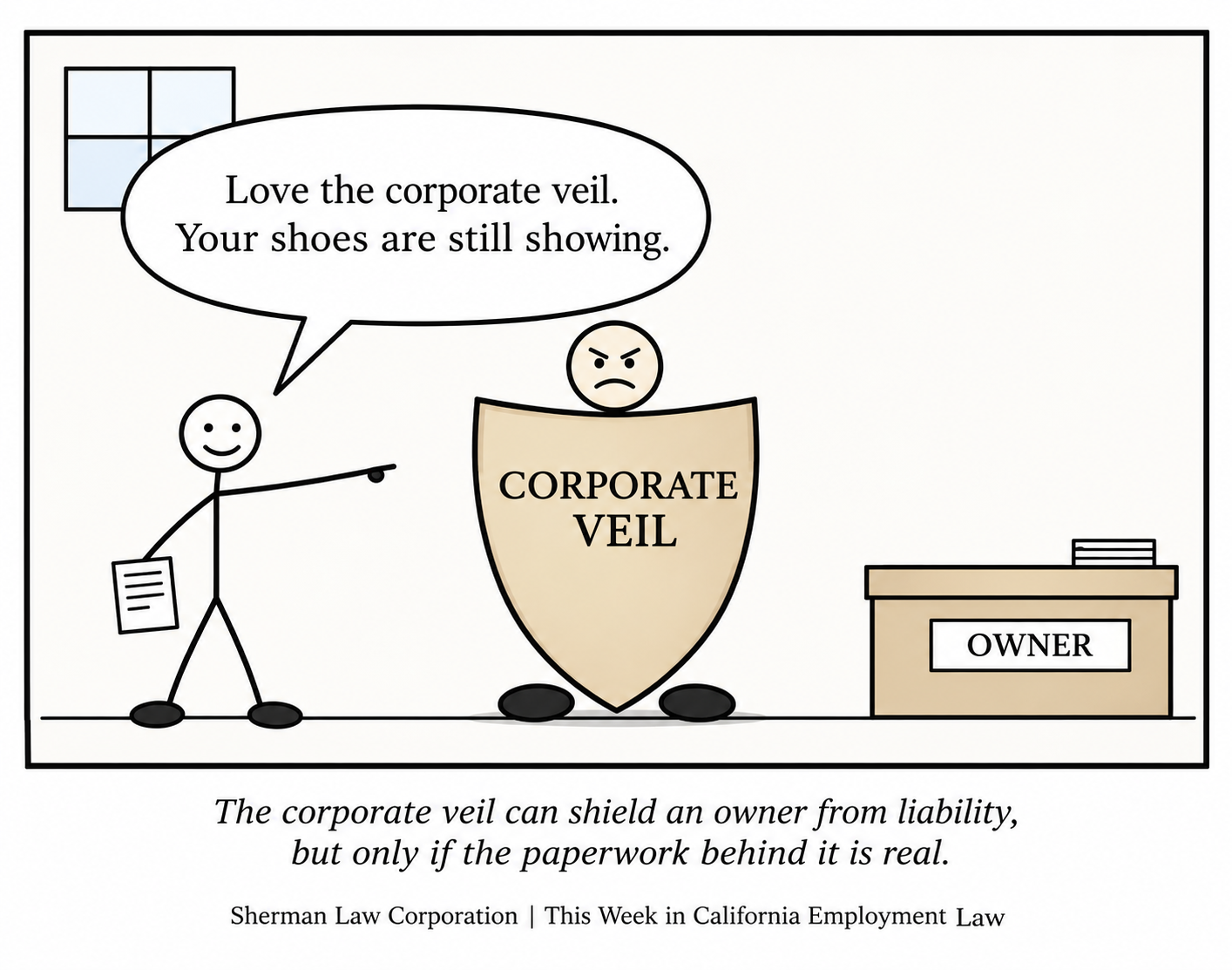
The harder question came next. Villasenor tried to collect that judgment not just from the corporations but from Kurt Schneiter, the individual who owned the companies through a chain of holding companies. California law generally presumes that a corporation is separate from its owner. To pierce the corporate veil and hold an owner personally responsible for the company’s obligations, a plaintiff must establish two things: that the owner and company have such a close unity of interest that they no longer function as genuinely separate entities, and that treating them as separate would lead to an unfair result. Evidence may include mixing personal and business funds, failing to follow corporate formalities, or using the company to commit fraud. No single factor automatically establishes alter ego liability. Villasenor argued that in FEHA cases, this presumption should flip so that owners would have to prove separateness themselves. The Court of Appeal disagreed and affirmed judgment for Schneiter. The court explained that this presumption only comes into play after a plaintiff has already won, so it does not discourage anyone from bringing a valid harassment or discrimination claim in the first place.
For employees, this is an important reality check. Winning a FEHA case against your employer is a major step, but if you hope to collect from the business owner personally, you will need separate proof that the corporate form was misused. For business owners, this case is a reminder that keeping your business and personal finances separate, following corporate formalities, and keeping your company adequately funded remains real protection, even when facing a FEHA claim. That protection is not automatic, though. It depends on actually respecting the corporate structure in practice.
When Unpaid Leave Can Satisfy a Religious Accommodation Request
The second case, Smith v. Burbank Unified School District, was originally decided on October 7. On October 22, the Court of Appeal denied a petition for rehearing and modified its opinion without changing the judgment. The decision provides useful guidance on when unpaid leave may qualify as a reasonable religious accommodation under FEHA. It involves a high school teacher who objected on religious grounds to his school district’s COVID-19 vaccine mandate. The district approved his religious exemption but said the only option available to unvaccinated teachers was an unpaid leave of absence, while the teacher asked instead to keep teaching in person with weekly testing and masking. The district said that alternative was not workable given the safety risks in a classroom setting.
The teacher went on unpaid leave for about a year, eventually took a job elsewhere, and later resigned. The district’s vaccine mandate was eventually lifted, and Smith remained eligible to return to his former position. He ultimately chose not to return because he had secured employment elsewhere, and he sued for religious discrimination and retaliation. The Court of Appeal affirmed summary judgment for the school district, holding that unpaid leave could be a reasonable religious accommodation under FEHA in these circumstances. The district supported its undue hardship argument with evidence about the operational problems it had experienced during the pandemic, as well as a sworn declaration explaining the logistical difficulties of accommodating unvaccinated teachers. Smith did not present evidence to counter those concerns. The court therefore found that the district had met its burden of showing that other reasonable accommodations would create an undue hardship.
FEHA also sets a specific standard for what qualifies as undue hardship. Under California Government Code section 12926(u), an employer must show that an accommodation would involve significant difficulty or expense. Courts consider factors such as the cost of the accommodation, the employer’s financial resources and size, and the nature of its operations. An employer cannot simply reject an employee’s preferred accommodation because it finds it inconvenient.
The takeaway for employees is that your employer does not have to give you the exact accommodation you ask for.
Have a Workplace Issue?
Whether you’re an employee or an employer, if you have a workplace issue you wish to discuss, contact Sherman Law Corporation at lisa@sherm-law.com or call 323-488-2087.
 This blog post is attorney advertising and is provided for general informational purposes only. It does not constitute legal advice and does not create an attorney-client relationship.
What Do These Decisions Mean for You?
1. I won a harassment judgment against my employer. Can I go after the owner personally?
Not automatically. California law presumes that a corporation is separate from its owner. To reach the owner’s personal assets, you must establish that the owner and company functioned as essentially the same entity and that treating them separately would lead to an unfair result. Evidence such as commingled funds, failure to follow corporate formalities, inadequate capitalization, or fraud may help establish these elements, depending on the circumstances. Winning the underlying FEHA claim is not enough on its own. Contact our employee representation team to assess whether the facts support a veil-piercing argument.
2. I own a small business through a holding company. Does Villasenor protect me from personal liability in a FEHA case?
It can, but only if you are genuinely respecting the corporate structure. The presumption of separateness is not automatic protection; it reflects the actual way you run the business. If you are mixing personal and business funds, skipping corporate formalities, or leaving the company underfunded, that protection is at risk. Consult employment counsel to make sure your structure holds up.
3. My employer offered me unpaid leave instead of the accommodation I asked for. Is that legal?
It can be, depending on the circumstances. Smith v. Burbank confirms that unpaid leave may qualify as a reasonable religious accommodation when the employer has considered other available options and can establish that those alternatives would create an undue hardship. The employer must support that position with evidence, not simply claim that accommodating the employee would be inconvenient. General or vague claims of hardship are not enough; the employer needs specifics. If you believe your employer did not genuinely explore alternatives or cannot back up its hardship claim, contact our office to discuss your options.
4. What evidence does an employer need to defend an unpaid leave accommodation?
The Smith decision highlights the importance of supporting an undue hardship defense with evidence. The district provided a sworn declaration explaining its operational concerns, along with evidence of the problems it had experienced during the pandemic. Employers should document the actual difficulties an accommodation would create, consider the employee’s proposed alternatives, and explain why those alternatives would not work. A general statement that an accommodation is too difficult or inconvenient is not enough on its own. If your business faces a similar situation, document the actual risks involved, who assessed them, and why each alternative was considered and rejected before offering unpaid leave as the only option.
5. Can an employee be retaliated against for requesting a religious accommodation?
Yes, and retaliation for requesting an accommodation is a separate claim from the accommodation itself. Even if the employer’s accommodation decision turns out to be lawful, retaliating against an employee for making the request is not. Smith also raised a retaliation claim, which was included in the summary judgment ruling affirmed on appeal. However, the court’s main discussion focused on the accommodation decision and the evidence supporting the district’s position. If you were disciplined, demoted, or terminated after raising a religious accommodation request, contact our employee representation team to discuss whether you have a retaliation claim.
6. Does the Smith decision change how courts handle religious accommodation cases going forward?
It reinforces the existing FEHA framework rather than establishing a blanket rule for unpaid leave. Employers must consider available reasonable accommodations and show that accommodating the employee would create an undue hardship. Under Government Code section 12926(u), that means significant difficulty or expense, assessed in light of factors such as the cost of the accommodation, the employer’s financial resources and size, and its operations. Smith also illustrates why employers need evidence to support their position and why employees challenging an accommodation decision need evidence that calls the employer’s reasoning into question. Employers who rely on conclusory hardship claims without documentation are unlikely to prevail. Employees challenging an unpaid leave accommodation need their own evidence showing the employer’s hardship claim does not hold up.