
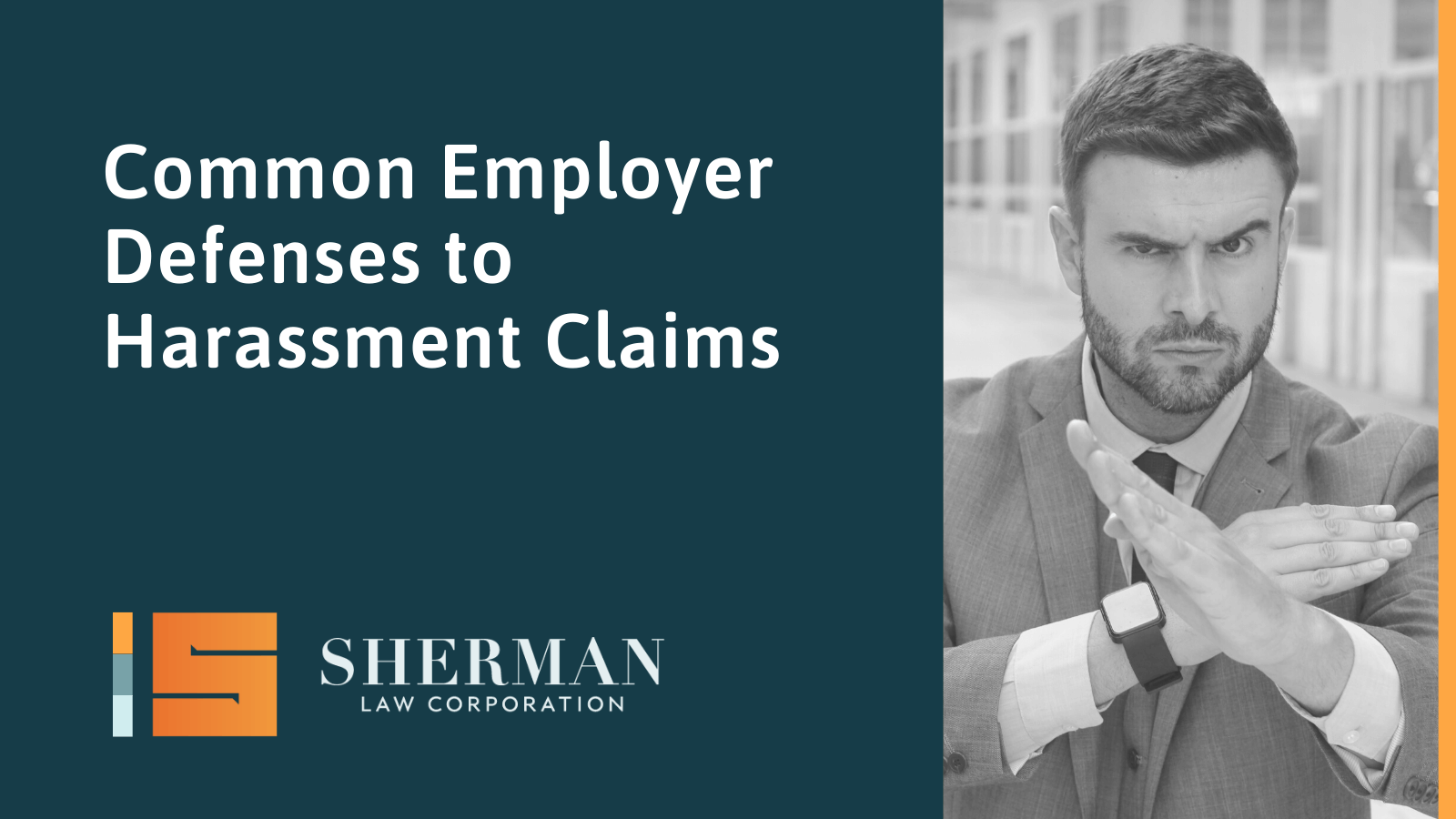
At Sherman Law Corporation, Attorney Lisa Sherman is familiar with a number of common employer defenses to harassment claims raised in response to unlawful harassment claims. These include:
- Statute of limitations bars lawsuits that are filed more than one year after the Civil Rights Department (CRD) Department of Fair Employment and Housing (DFEH) issues a right to sue letter.
- Failure to exhaust administrative remedies bars California Fair Employment and Housing Act (FEHA) claims that are not filed with the CRDDFEH within three yearsone year of the unlawful act (with some exceptions for continuing violations).
- The complainant has no standing; i.e., is not an applicant, employee, unpaid intern, volunteer, or person providing services pursuant to a contract of the employer or employee of the employer or other covered entity.
- The alleged conduct was not severe or pervasive to create an abusive, hostile work environment;
- The alleged conduct was not unwelcome.
- The alleged conduct did not create an objectively hostile work environment to a reasonable person with the same protected characteristics standing in the shoes of the complainant.
- The alleged conduct did not create a subjectively hostile work environment to the complainant.
- The complainant was not harmed.
- The alleged harassing conduct was not a substantial factor in causing the complainant’s harm.
- The complainant’s actions are reduced barred, in whole or in part, by the doctrine of avoidable consequences.
For more information on employer defenses to harassment claims, feel free to contact our office at (424) 249-3631. Take note that your company may be legally responsible to pay for the defense of an accused named in a sexual harassment lawsuit.
| Related Links: |
Frequently Asked Questions
1. What is the statute of limitations for filing a harassment lawsuit in California?
Under Government Code §12965, an employee has one year from the date the CRD issues a right-to-sue letter to file a civil lawsuit. Separately, under Government Code §12960, employees must file a complaint with the CRD within three years of the unlawful act before they can pursue a lawsuit.
2. What does “failure to exhaust administrative remedies” mean?
Before filing a harassment lawsuit in California, an employee must first file a complaint with the CRD. If they skip this step, the court can bar their lawsuit entirely. This is known as failure to exhaust administrative remedies.
3. Who has “standing” to bring a harassment claim under FEHA?
Under Government Code §12940(j), only applicants, employees, or others covered by FEHA can bring a harassment claim. If the complainant does not fall into one of these categories, the employer may raise a lack of standing as a defense.
4. What does “severe or pervasive” mean in the context of harassment claims?
To be legally actionable, harassing conduct must be severe or pervasive enough to create an abusive work environment. Government Code §12923 sets out California’s standard, which is more employee-protective than federal law and recognizes that even a single incident can, in some circumstances, be sufficient.
5. What is the doctrine of avoidable consequences?
The avoidable consequences doctrine allows an employer to limit its damages, not avoid liability entirely, by showing that (1) it took reasonable steps to prevent and correct harassment; (2) the employee unreasonably failed to use those measures; and (3) doing so would have prevented some or all of the harm.
6. Can a harassment claim be dismissed if the complainant was not harmed?
Yes. Harm to the complainant is a required element of a harassment claim. If the employer can show that the complainant suffered no actual harm or that the alleged conduct was not a substantial factor in causing any harm, this can be a complete or partial defense to the claim.