
Two Court of Appeal decisions and a $2 million Labor Commissioner enforcement action round out the last two weeks. A police officer’s vaccine termination case clarifies when FEHA cost awards apply, a UCLA hiring case shows that a Fair Chance Act violation alone won’t win damages, and a decade-old business closure serves as a reminder that the state will come after wages owed, including from the owner personally. Sherman Law Corporation handles employment litigation for employees and employers across California.
Picking up where my last October update left off, here is what happened in California employment law over the past two weeks. Two Court of Appeal decisions and a significant enforcement action out of the Labor Commissioner’s Office are worth a few minutes of your time, whether you’re an employee trying to understand your rights or an employer trying to stay out of trouble.
Vaccine Mandates, Police Officer Rights, and FEHA Costs
In the Cruz v. City of Hermosa Beach case, a police officer who was fired after refusing a COVID-19 vaccine (he had requested a religious exemption that was denied) sued the City. He argued that his termination violated the special procedural protections police officers get under state law, and also that it amounted to unlawful retaliation under California’s main anti-discrimination law, FEHA.
The Court of Appeal sided with the City on the officer-protections issue. It held that those special procedural rights are meant to protect officers from being individually disciplined or singled out, not to apply to a general policy like a vaccination requirement that applies to everyone in a job category. In plain terms, if a safety rule applies across the board to all employees in a role, it is treated differently than if an employer is singling out one employee for discipline.
The court also addressed a separate point that matters to anyone who has ever worried about the cost of bringing a discrimination claim. California law allows an employer who wins a FEHA case to recover certain costs from the employee who sued, but only if the court specifically finds the claim was frivolous or completely without merit. The Court of Appeal reinforced that this is a high bar and trimmed back the costs the City could recover because that finding had not properly been made. For workers considering whether to bring a discrimination claim, this is a reassuring reminder that simply losing your case does not automatically mean you will be stuck paying the other side’s costs.
Background Checks and the Fair Chance Act
California’s Fair Chance Act (sometimes called a “ban the box” law) requires employers to give job applicants a fair opportunity to explain a criminal record before pulling a job offer. Specifically, if an employer decides to withdraw a conditional job offer because of something in a background check, it must give the applicant at least five business days to respond with evidence of rehabilitation or other mitigating information. California prohibits employers from inquiring about conviction history before making a conditional offer.
In the McInerney v. Regents of the University of California case, a UCLA job applicant was removed from the work schedule after the university learned of decades-old felony drug convictions. The trial court agreed that UCLA had skipped the required five-day waiting period, but the jury still found the applicant had not suffered any real harm from that shortened window, so he did not win damages. The Court of Appeal upheld that result, making clear that a paperwork violation of the Fair Chance Act, by itself, is not enough to win money damages. A worker has to show that the shortcut actually caused them harm.
For employers, the takeaway is not that the five-day rule can be ignored. It is still the law, and a worker who can show real harm from a skipped waiting period can still recover. But this case shows that the courts will not automatically award damages just because a step was missed. For job applicants, it is a reminder to document how a rushed decision affected you (lost income, a withdrawn offer you could have saved with more time) rather than assuming the violation alone guarantees a payout.
A $2 Million Reminder on Closing a Business the Right Way
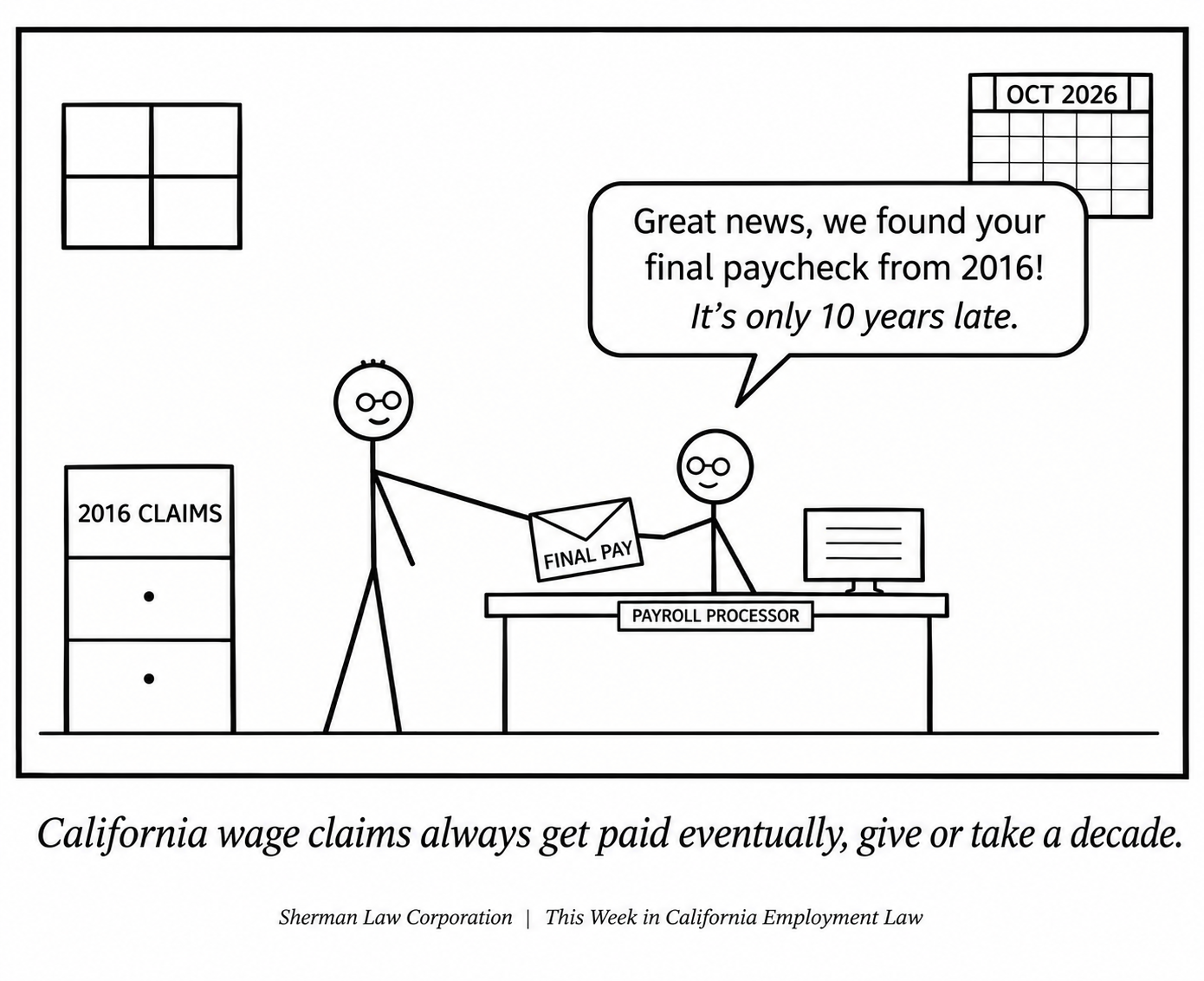
Outside the courts, the California Labor Commissioner’s Office announced it has recovered roughly $1.988 million for 136 former employees of Capital Mailing Services, Inc., a West Sacramento mailing company. The company closed abruptly back in 2016 without giving workers the advance notice required by California’s WARN Act and without paying out their final wages.
This recovery was years in the making. After a 2018 enforcement lawsuit, the Court of Appeal upheld a $1.3 million judgment against the company, and the state went a step further, pursuing the company owner personally under a fraudulent-transfer theory, ultimately collecting roughly $688,000 directly from him.
One point of law worth being precise about: California’s WARN Act advance-notice requirement does not apply to every business. It only applies to what the law calls a “covered establishment,” generally an employer that has employed 75 or more people within the preceding 12 months (the separate federal WARN Act uses a 100-employee threshold and its own counting rules). If your business is smaller than that, Cal-WARN’s notice requirement likely does not apply to you. What does apply to employers of every size, though, is the obligation to pay final wages promptly when someone’s employment ends. That requirement has no size cutoff, and a late final paycheck can trigger waiting-time penalties no matter how small the business is. For larger employers closing a facility or laying off staff, both the notice rule and the final-pay rule are in play; for smaller employers, it is the final-pay rule you need to get right. For employees, this case is a good example of why it is worth pursuing unpaid final wages even years later. The state’s enforcement arm does not give up easily, and neither should you.
Have a Workplace Issue?
Whether you’re an employee or an employer, if you have a workplace issue you wish to discuss, contact Sherman Law Corporation at lisa@sherm-law.com or call 323-488-2087.
 This post is attorney advertising and is intended for general informational purposes only. It does not constitute legal advice and does not create an attorney-client relationship. For advice about your specific situation, please consult a licensed attorney.
What Do These Decisions Mean for You?
1. I lost my FEHA discrimination case. Does that mean I have to pay the employer’s legal fees?
Not automatically. California law only allows an employer to recover costs from a losing FEHA plaintiff if the court makes a specific finding that the claim was frivolous or completely without merit. Simply losing is not enough. The Cruz decision reinforces that courts will scrutinize whether that finding was properly made before allowing cost recovery. If you are concerned about fee exposure in a discrimination case, contact our office for a consultation before deciding whether to proceed.
2. My employer skipped the five-day waiting period required under the Fair Chance Act. Can I sue?
You may have a claim, but the McInerney decision makes clear that the violation alone is not enough to win damages. You will need to show that the shortened window actually caused you harm, such as lost wages from a job you would have kept if given more time to respond. Document what you lost: income, the offer itself, and whether additional time to provide rehabilitation evidence would have changed the outcome.
3. Does a general workplace policy treat me the same as individual discipline under California law?
Not always. The Cruz case illustrates that policies applied uniformly across an entire job category, like a vaccination requirement for all officers in a role, are analyzed differently than individual disciplinary decisions targeting a single employee. The procedural protections that apply to individual discipline may not apply when a rule covers everyone in the same category equally.
4. Our company is planning to close or do significant layoffs. What do we have to give employees?
It depends on your size. If you have employed 75 or more people in the past 12 months, California’s WARN Act requires advance written notice before a mass layoff or facility closure. Regardless of size, you must pay all final wages promptly, and a late final paycheck can trigger waiting-time penalties. The Capital Mailing case is a reminder that these obligations do not go away when a business closes and that owners can be pursued personally if assets are transferred to avoid paying workers. Consult employment counsel before announcing a closure or layoff.
5. Can the state come after a business owner personally for unpaid wages?
Yes, under certain circumstances. In the Capital Mailing case, the Labor Commissioner pursued the owner personally under a fraudulent transfer theory after the company’s assets had been moved. Business owners who close a company while owing wages should understand that dissolving the entity does not automatically extinguish that liability, particularly if assets were transferred in a way that looks designed to avoid paying workers.
6. I was denied a job because of an old conviction. What are my rights?
California’s Fair Chance Act requires employers to conduct an individualized assessment before withdrawing a conditional job offer based on a criminal record and to give you at least five business days to respond with rehabilitation evidence or other mitigating information. If an employer skipped that process entirely, you may have a claim, though as the McInerney decision makes clear, you will need to show actual harm to recover damages. Contact our employee representation team to discuss your situation.