
Three Court of Appeal decisions in two weeks. A teacher’s vaccine exemption case draws the line on when unpaid leave satisfies a religious accommodation, a discrimination plaintiff avoids a $15,000 cost award by appealing a procedural shortcut, and a California court refuses to enforce a mandatory arbitration agreement when federal law doesn’t apply. Sherman Law Corporation handles employment litigation and employee representation for California employees and employers.
It has been a busy few weeks for California employment law, with the Courts of Appeal weighing in on three issues that matter to both workers and business owners: how far an employer has to go to accommodate an employee’s religious beliefs, whether an employee who loses a discrimination case has to pay the company’s legal bills, and whether companies can force new hires into arbitration as a condition of getting the job. Here is what happened and what it means for you.
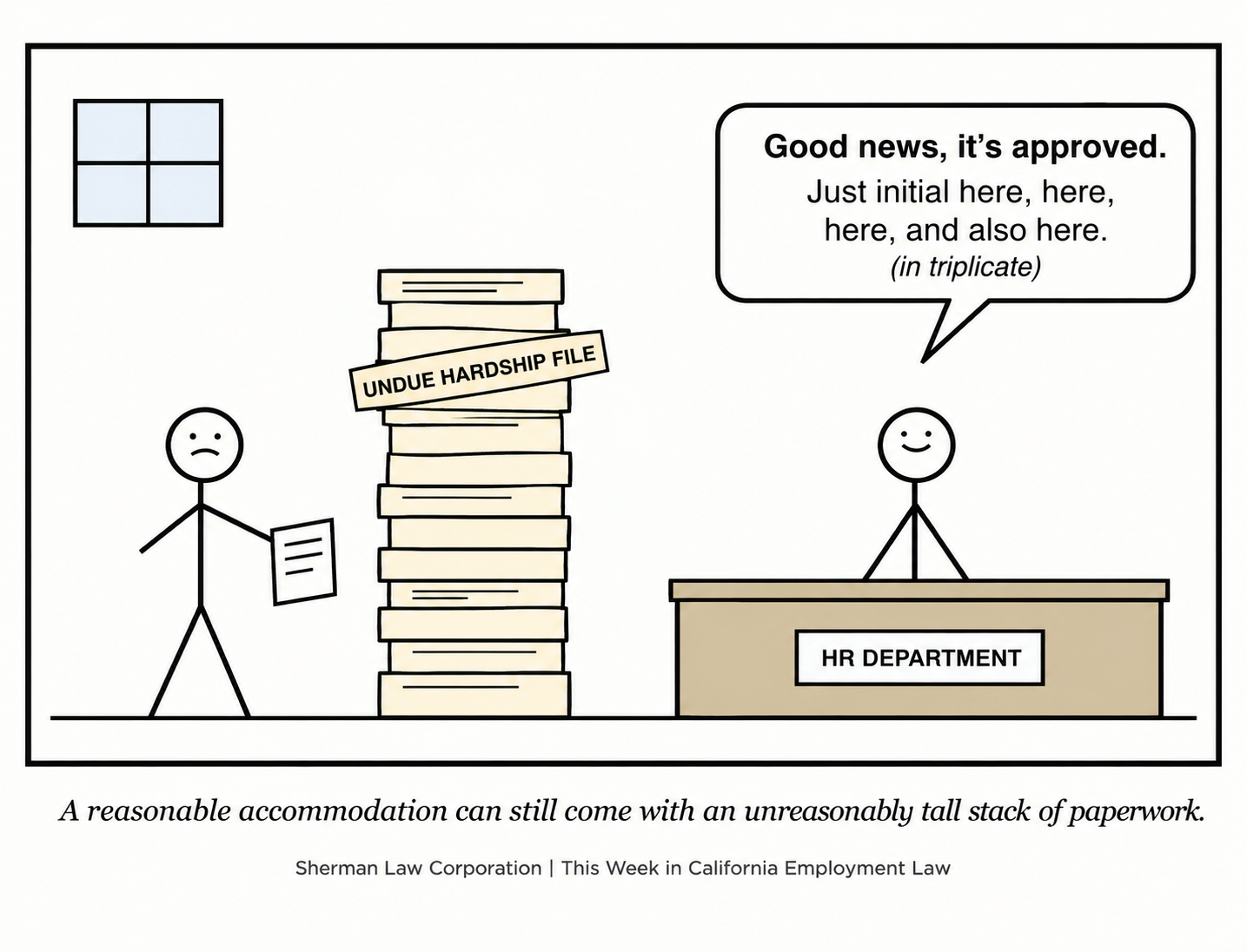
When Is Unpaid Leave a Good Enough Accommodation?
In Smith v. Burbank Unified School District, the Court of Appeal looked at a case brought by a longtime high school teacher whose Christian faith led him to object to Burbank Unified’s COVID-19 vaccine mandate. The District granted his religious exemption, but said the only accommodation it could offer was unpaid leave. It would not let him keep teaching in person using masking and weekly testing instead. He took unpaid leave, kept asking for a testing-based alternative, was turned down, and eventually left to teach at a school with no vaccine mandate. He sued for religious discrimination, failure to prevent discrimination, and retaliation under the Fair Employment and Housing Act, or FEHA (Gov. Code § 12900 et seq.). Both the trial court and the Court of Appeal sided with the District.
The court’s reasoning matters for anyone navigating a workplace accommodation dispute. The District was able to show, with real evidence, that testing in place of vaccination would have created an undue hardship given the health risks involved, and that in-person teaching was simply an essential part of the job, so remote work was not a workable substitute. Just as important, the District treated everyone consistently: teachers with daily student contact got unpaid leave, while employees without that contact were offered other options. That consistency is part of what convinced the court there was no intentional discrimination.
For employees, the takeaway is not that “my employer offered leave instead of what I wanted” is automatically unlawful. Courts will look at whether the employer genuinely explored alternatives and can back up its reasons with evidence. For employers, the case is a reminder that unpaid leave can be a lawful accommodation, but only if you can document why nothing less restrictive would have worked, and only if you apply your policy evenhandedly across your workforce.
Losing a FEHA Case Doesn’t Automatically Mean Paying the Employer’s Costs
A second decision, San Diego-Tomas v. Aspire Bakeries, LLC, addresses a question that worries a lot of employees before they ever file a case: what happens financially if I lose? Cecilia San Diego-Tomas sued her former employer for discrimination and retaliation, along with other claims, and lost on summary judgment. She did not appeal that loss. What she did appeal was the trial court’s decision to let her former employer recover over $15,000 in costs, simply because the company filed a routine costs form, the same kind any winning defendant in an ordinary lawsuit might file.
The Court of Appeal reversed. Under Government Code § 12965(c)(6), an employer who wins a FEHA case is not automatically entitled to its costs the way it would be in a typical civil lawsuit. Instead, the employer has to formally ask the court for costs, and the court has to specifically find that the employee’s case was frivolous, unreasonable, or groundless when it was filed, or that the employee kept pushing it forward after it clearly became so. Just filing the standard paperwork is not enough.
This is good news for employees weighing whether to bring a good-faith discrimination or retaliation claim. California law is built to protect workers who bring legitimate claims from being automatically saddled with their employer’s legal bills just because the case did not ultimately succeed. That protection exists precisely so that the fear of a costly loss does not stop people from standing up for their rights at work.
Employers Cannot Force Arbitration as a Condition of Hiring, At Least Not Without the Federal Arbitration Act’s Help
The third case, Molina v. Triumph Residential Services, Inc., tackles mandatory arbitration agreements, the paperwork many employees are asked to sign at hiring that requires them to resolve disputes in arbitration instead of court, and to give up the right to bring class or group claims. Tiffany Molina worked for a Los Angeles property management company and was given one of these agreements as part of her onboarding. She later brought a wage and hour class action, and the company tried to force the case into arbitration.
California’s Labor Code (§ 432.6) generally makes it illegal for an employer to require arbitration as a condition of employment. There is an exception when the agreement is enforceable under the Federal Arbitration Act, but here, both sides agreed that federal law simply did not apply to this agreement. Without that exception available, the Court of Appeal held that ordinary California contract law controlled, and California law does not enforce a contract that was illegally imposed in the first place. The court also rejected the company’s argument that Molina was “free to” negotiate out of the agreement or look for another job. Making an employee take extra steps to avoid a provision, the court said, is itself a way of making that provision a condition of employment.
This is an important, worker-protective decision. When federal arbitration law does not apply, an employer cannot simply require arbitration as a condition of getting or keeping a job, and telling an employee they were “free to” push back or walk away is not a legal escape hatch. For employers, this case is a good reason to have counsel confirm whether your arbitration agreements actually qualify for federal coverage and to review onboarding materials to make sure they do not suggest signing is non-negotiable.
Have a Workplace Issue?
Whether you’re an employee or an employer, if you have a workplace issue you wish to discuss, contact Sherman Law Corporation at lisa@sherm-law.com or call 323-488-2087.
 This post is attorney advertising and is intended for general informational purposes only. It does not constitute legal advice and does not create an attorney-client relationship.
What Do These Decisions Mean for You?
1. My employer offered me unpaid leave instead of the accommodation I asked for. Is that enough?
It can be, but it depends on whether your employer can show that your preferred accommodation would have created an undue hardship and that unpaid leave was genuinely the only workable option. Courts also look at whether the policy was applied consistently across employees in similar roles. If workers in comparable positions were treated differently, that inconsistency can support a discrimination claim. Contact our office if you believe you were singled out.
2. Will I have to pay my employer’s legal fees if I lose a discrimination case?
Not if your claim was brought in good faith. Under California law, an employer cannot recover its costs in a FEHA case simply by filing the standard paperwork after winning. The court must make a specific finding that your claim was frivolous or groundless, either when filed or at some point along the way. Contact an employee representation attorney to assess your situation before deciding.
3. Can I sue in court if I signed an arbitration agreement when I got hired?
Possibly. California law generally prohibits employers from making arbitration a condition of employment. The Molina decision confirms that telling an employee they were “free to” push back does not get the employer off the hook. Whether that prohibition applies to your agreement depends on whether federal law covers it: if it does, the employer has more protection; if it does not, California’s rule likely controls, and the agreement may not be enforceable.
4. Are our arbitration agreements still enforceable after the Molina decision?
They may be, depending on how the agreement is presented and whether the Federal Arbitration Act covers it. If the FAA applies, you have more protection. If it does not, and your onboarding materials suggest that signing is mandatory or non-negotiable, this decision puts you at risk. Consult employment counsel to confirm whether your agreements qualify for federal coverage and whether your onboarding process needs adjustment.
5. What makes a religious accommodation request valid under California law?
An employee needs to show a sincerely held religious belief that conflicts with a workplace requirement and that they requested an accommodation. The employer then has to show either that it offered a reasonable accommodation or that every reasonable option would have created an undue hardship. The Smith decision shows that unpaid leave can satisfy that obligation when the employer documents why no lesser option was available and applies the policy consistently. Understanding the burdens of proof in FEHA claims can help both sides evaluate where they stand.
6. Does winning a discrimination case automatically entitle employers to recover costs?
No. The employer must make a formal request, and the court must find the claim was frivolous or groundless, not just unsuccessful. This is a higher bar than what applies in ordinary civil litigation, and it is intentional. California law is designed to encourage employees to bring good-faith claims without fear that a loss will leave them with a second financial blow. Reach out if you have questions about what you could owe, or be owed, after an employment case.