
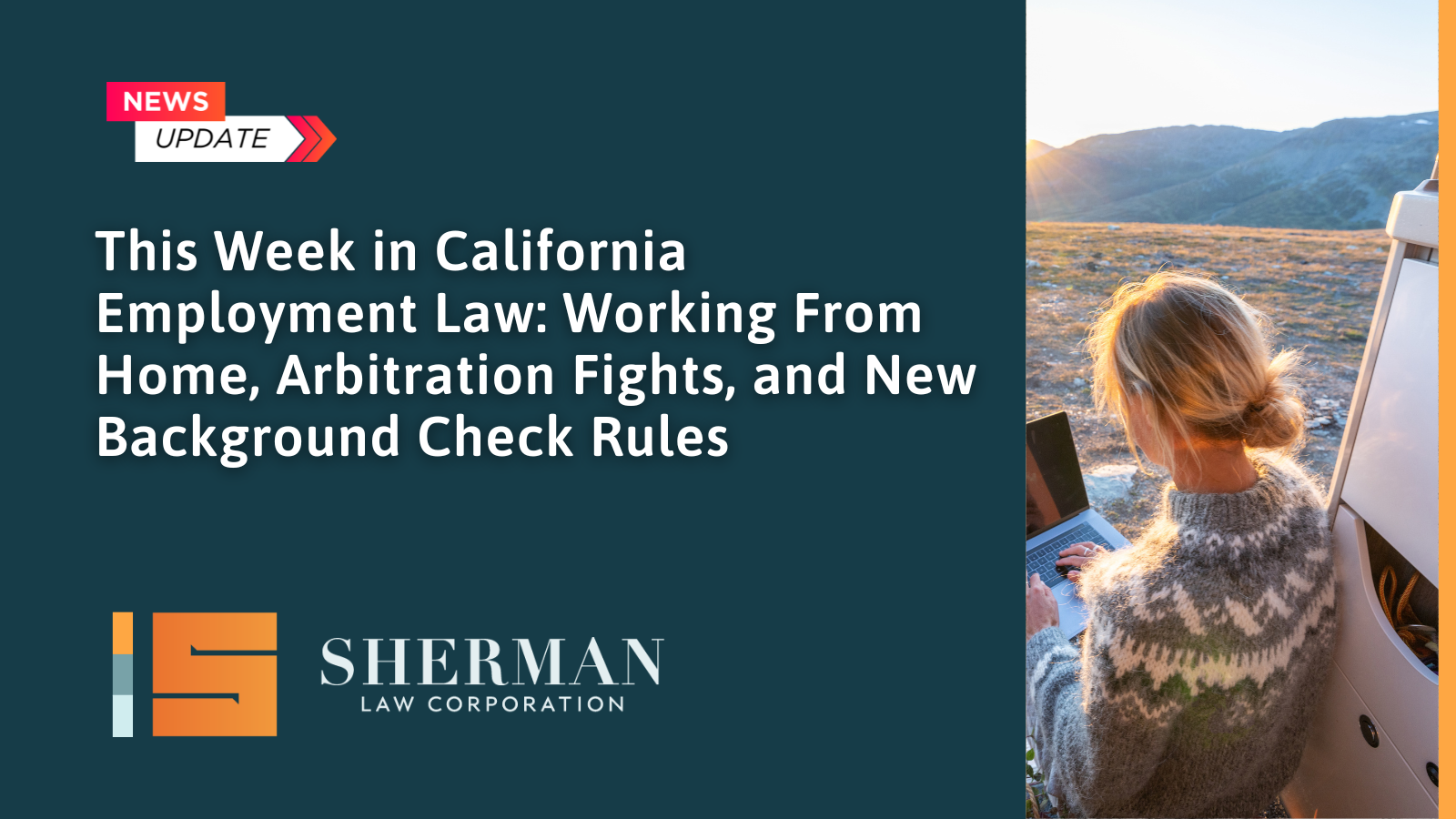
New federal guidance confirms that return-to-office mandates do not eliminate the duty to accommodate disabled employees. A court in Northern California draws a harder line on who can use the federal EFAA to avoid arbitration. And San Francisco’s background check rules get significantly tighter starting August 10.
If you are an employer rolling out a return-to-office policy, an employee wondering whether your arbitration agreement can be challenged, or a San Francisco business about to run background checks, this week’s developments affect you directly. They are the kind of changes that show up in real disputes, real terminations, and real lawsuits. At Sherman Law Corporation, our employment litigation practice watches these developments closely so you don’t have to. Here is what happened and what it means for you.
Welcome back to my weekly roundup of what is happening in California employment law. This week brought new federal guidance on remote work accommodations, a court decision that limits when workers can dodge arbitration in sexual harassment cases, and a set of new rules for employers in San Francisco who run background checks. Here is what you need to know, in plain English.
Return-to-Office Mandates Do Not Erase the Duty to Accommodate
The Equal Employment Opportunity Commission issued new guidance this week making clear that a strict return-to-office policy does not automatically end an employer’s obligation to consider telework as a reasonable accommodation for an employee with a disability. In other words, just because a company says everyone must be in the office does not mean it can skip the conversation about whether a particular employee needs to work from home for medical reasons.
The guidance points to two recent court decisions to illustrate the point. In one, a federal court in Washington, D.C., refused to let an employer off the hook after it took away a breast cancer survivor’s full-time telework accommodation. In the other, the Fifth Circuit sided with an employer that denied a full-time telework request from an Army contractor because showing up in person was truly an essential part of that particular job. Both of these cases involve federal disability law from outside California, not California’s own Fair Employment and Housing Act, but California courts often look to these federal cases for guidance since our state law is modeled on the same framework.
For employees, this means that if you have a medical condition and your employer has a return-to-office policy, you still have the right to ask for accommodations, and your employer still has to genuinely engage with that request rather than issuing a blanket denial. For employers, the lesson is to document a real, individualized conversation with each employee before deciding that in-person work is required, rather than relying on a one-size-fits-all policy.
Court Limits When Sexual Harassment Claims Can Skip Arbitration
Many employees sign arbitration agreements as part of their job, which usually means workplace disputes get resolved by a private arbitrator instead of in court. A few years ago, Congress passed a law giving people who experience sexual assault or sexual harassment at work a way around that, allowing them to go to court even if they signed an arbitration agreement.
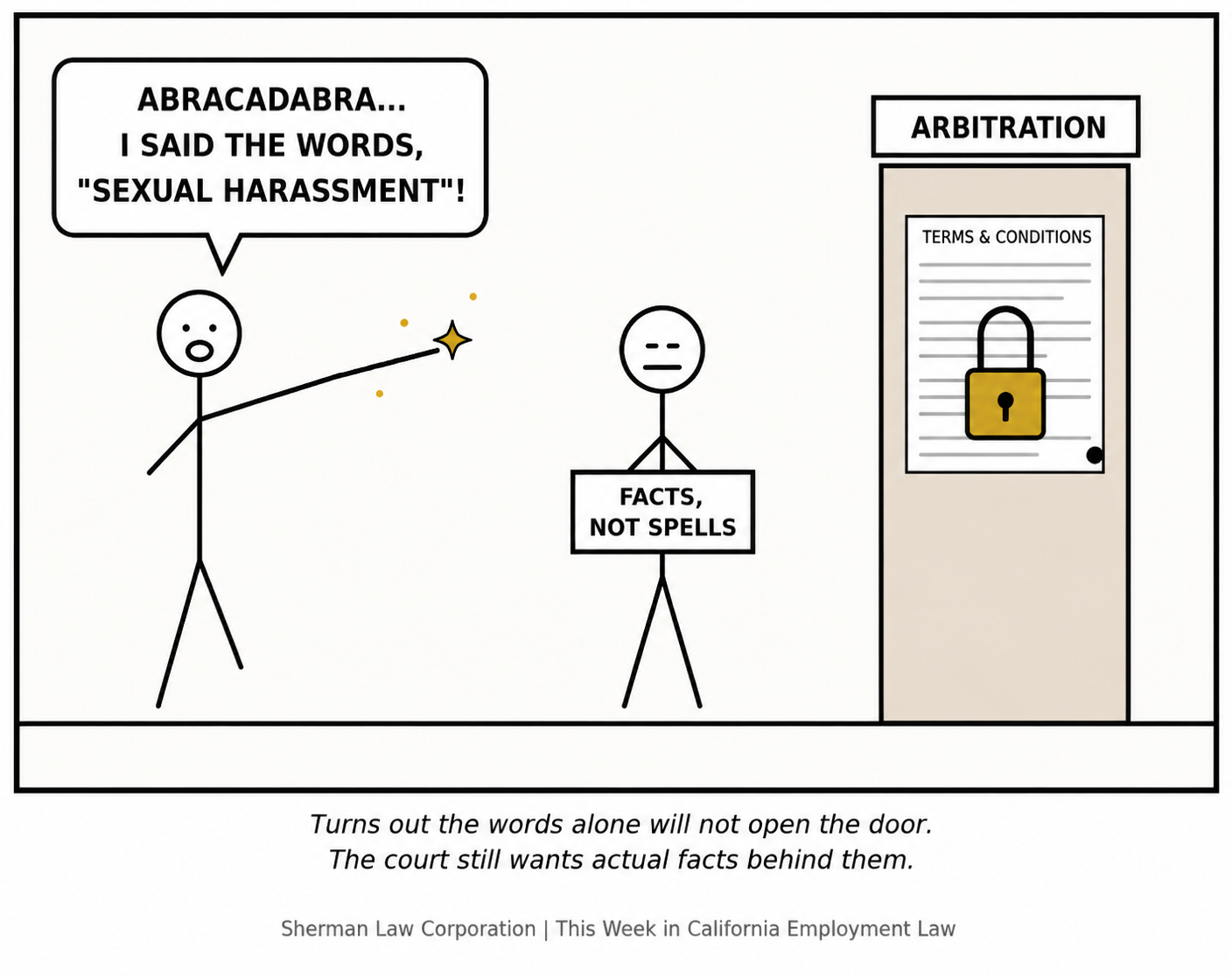
This week, a federal court in Northern California, in a case called Ai v. Tencent America LLC, held that simply calling a claim sexual harassment is not enough to use that carve out. The employee has to actually describe conduct that is serious or repeated enough to count as real harassment under the law. In this case, the employee also brought equal pay, overtime, whistleblower retaliation, and age discrimination claims, and since those claims did not qualify for the carve out, the court sent them to arbitration anyway.
This case is part of a growing trend of courts requiring specifics, not just labels, before letting someone avoid arbitration. If you believe you have been sexually harassed at work and you want to preserve your right to go to court instead of arbitration, it is important to describe what actually happened in detail. A vague or conclusory claim may not be enough.
San Francisco Tightens Background Check Rules Starting August 10
If you run a business in San Francisco, or you are a job applicant there, pay attention to this one. Amendments to San Francisco’s Fair Chance Ordinance take effect on August 10, 2026. The ordinance applies to employers with five or more employees who have positions involving at least eight hours of work per week in the city.
Under the new rules, covered employers can no longer take an adverse action, such as rescinding a job offer, based on an out-of-state conviction or an unresolved arrest if the underlying conduct would have been legal in California and relates to abortion care, gender-affirming care, drag performances, or a spontaneous abortion. The amendments also add firm new deadlines to the process. Employers must confirm they received an applicant’s response within 14 days, must pause before taking action for a reasonable period after that, must withdraw the proposed adverse action if the applicant makes a reasonable showing that the conviction has nothing to do with the job, and must issue a final decision within 30 days. Penalties and available damages for violations are going up as well.
San Francisco’s rules already went beyond California’s statewide Fair Chance Act, and now the gap is even wider. If your business has any San Francisco employees or positions, this is a good time to review your background check and adverse action process to make sure it lines up with these new deadlines before August 10.
Have a Workplace Issue?
Whether you’re an employee or an employer, if you have a workplace issue you wish to discuss, contact Sherman Law Corporation at lisa@sherm-law.com or call 323-488-2087.
 This blog post is attorney advertising and is intended for general informational purposes only. It does not constitute legal advice and does not create an attorney-client relationship. For advice about your specific situation, please consult a licensed attorney.
What Do These Decisions Mean for You?
1. My company has a return-to-office policy. Do I still have to consider remote work as an accommodation?
Yes. The new EEOC guidance makes clear that a blanket return-to-office policy does not eliminate the duty to individually assess whether remote work is a reasonable accommodation for an employee with a disability. You must engage in a genuine, documented conversation with the employee before concluding that in-person attendance is essential for their specific role. Our counseling practice can help you structure that process correctly.
2. I signed an arbitration agreement. Can I still take my sexual harassment case to court?
Possibly, but the Ai v. Tencent decision shows that vague allegations may not be enough. To use the federal EFAA carve-out, you need to describe conduct that actually qualifies as sexual harassment under the law, not just label it as such. The more specific and detailed your account of what happened, the stronger your argument for staying out of arbitration. Contact our office before filing anything to understand your options.
3. Does the Ai v. Tencent ruling change the California EFAA case law we have been following?
Not directly. Ai v. Tencent is a federal district court decision, not a California appellate ruling. The line of California cases starting with Doe v. Second Street Corp. remains the controlling authority in California state courts. What this week’s decision does signal is that federal courts are looking more carefully at whether harassment allegations actually meet the legal threshold before granting EFAA protection.
4. My San Francisco business uses a background check process. What do I need to change before August 10?
Review your adverse action timeline against the new deadlines: 14 days to confirm receipt of an applicant’s response, a pause period before acting, and a final decision within 30 days. Also check whether any of your current screening practices involve out-of-state convictions or arrests that would fall under the new exemptions.
5. Does California’s statewide Fair Chance Act apply to my business if I am not in San Francisco?
Yes. California’s statewide Fair Chance Act applies to employers with five or more employees anywhere in the state. San Francisco’s ordinance goes further and applies different and stricter rules for positions in the city. If you operate in both, you need to comply with both.
6. How can Sherman Law Corporation help with any of these issues?
Whether you are navigating a return-to-office accommodation request, assessing your arbitration agreements, or updating your background check process ahead of a new deadline, Sherman Law Corporation works directly with employers and employees to give you a clear picture of where you stand. Contact Lisa at lisa@sherm-law.com or call 323-488-2087.