
A California wage and hour class action worth $75 million unraveled on appeal after nineteen years. A court also looked past an employer’s harassment policy to examine whether religious views were the real reason for a firing, a well-drafted arbitration agreement survived a legal challenge, and California’s Civil Rights Department reminded employers what disability accommodation actually requires.
This was a busy week for employment law, with courts weighing in on arbitration agreements, a nearly two-decade-old wage case, and how far employers can go when disciplining workers for speaking their minds at work. There was also a helpful reminder from a state agency about disability accommodations.
At Sherman Law Corporation, our employment litigation practice monitors these developments closely, so your business stays protected. Here is what stood out and what it actually means if you are an employee or a business owner in California.
When “Anti-Harassment Policy” Becomes a Cover Story
In Brown v. Alaska Airlines, two flight attendants were fired after they posted comments on the airline’s internal intranet objecting, on religious grounds, to the company’s endorsement of the Equality Act. A lower court had sided with the airline, but the Ninth Circuit reversed. The court said there was enough evidence for a jury to decide whether the workers were really fired for their religious views, not for violating any harassment policy as the airline claimed.
This case is a federal case, not a California FEHA case, but it sends an important signal. Employers sometimes point to a harassment policy violation to justify a termination that may really be about punishing an employee’s protected views or religious expression. This ruling shows that courts are willing to look past that explanation and let a jury decide what really happened.
If you are an employee who was disciplined or fired shortly after expressing a religious or personal viewpoint at work, this case is a reminder that the stated reason for your termination is not always the end of the story. If you are an employer, it is a reminder to make sure any discipline tied to workplace speech is applied evenhandedly and is well documented, not just labeled a policy violation after the fact.
Arbitration Agreements Just Got a Clearer Roadmap
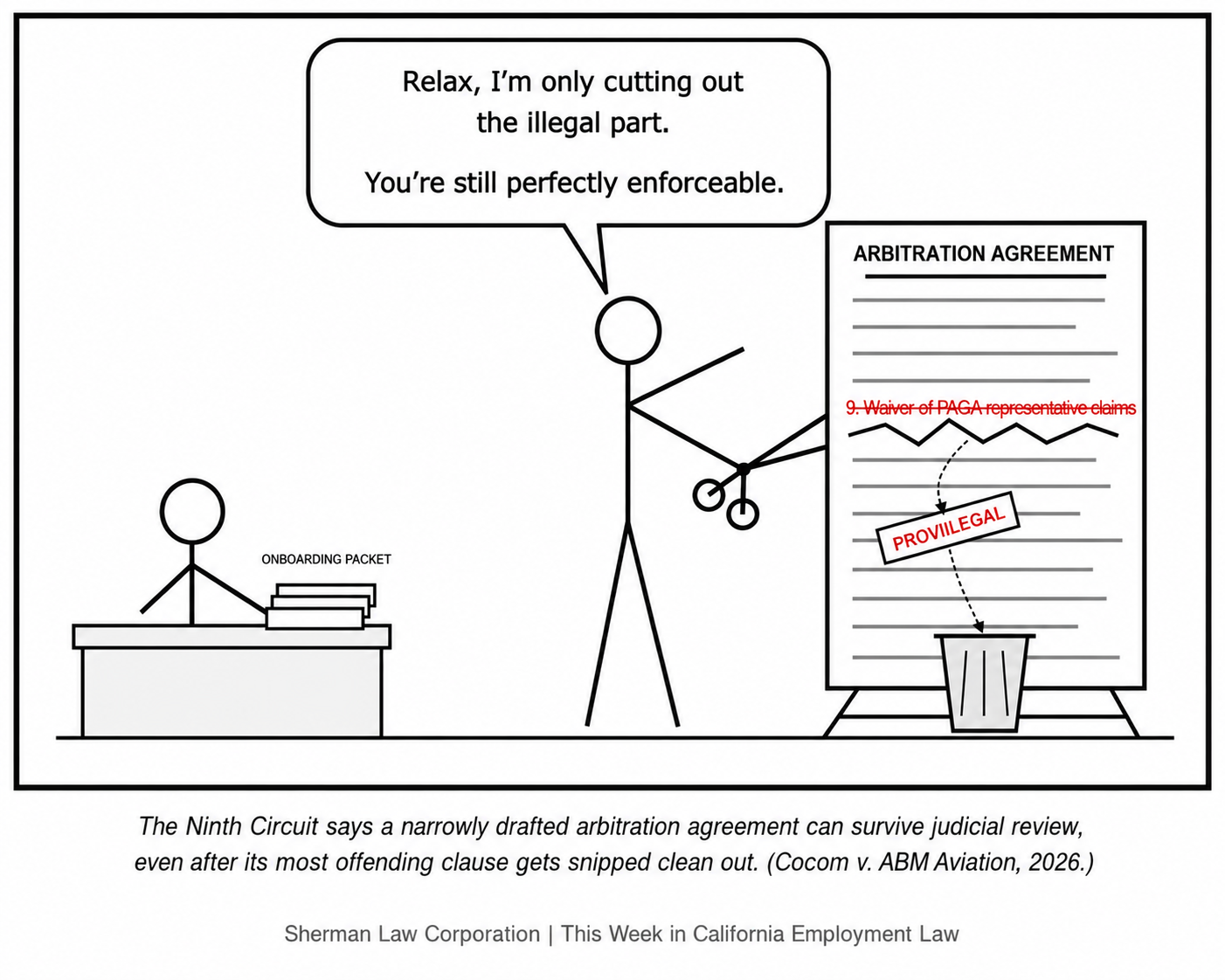
In Cocom v. ABM Aviation, an airport janitor tried to bring a wage-hour class action against his employer. The company wanted to move the case into arbitration instead of court, but the trial court refused, finding the arbitration agreement unfair. The Ninth Circuit reversed, holding that the agreement was not unfair because it was narrowly written to cover only employment-related disputes. The court also said that even though the agreement contained a provision waiving the employee’s right to bring a representative PAGA claim, that one provision could simply be cut out of the agreement.
For employees, this is worth knowing: if you signed an arbitration agreement when you were hired, courts are increasingly willing to enforce it, even if part of it goes too far, as long as the rest of the agreement is reasonably written. Do not assume a flawed clause automatically frees you from arbitration entirely.
For employers, this case is good news. It shows that a narrowly drafted arbitration agreement, paired with a severability clause (language that lets a court remove a bad provision instead of striking the whole agreement), can survive a legal challenge. If your arbitration agreements are broad, outdated, or missing severability language, this is a good time to have them reviewed.
A $75 Million Verdict Unravels After Nineteen Years
Cortina v. North American Title Company is a striking example of how long wage-hour litigation can drag on and how much can change on appeal. Escrow officers claimed they were wrongly classified as exempt from overtime pay. A 2016 trial resulted in a judgment of $43 million, which grew to nearly $75 million once fees and interest were added. This month, the Court of Appeal reversed most of that judgment. The court found that the trial had relied too heavily on statistics to prove damages for the whole class and that the damages phase had been improperly handed off to a private referee without the parties’ agreement. The class was decertified as a result.
For workers, this case is a reminder that even a huge trial win is not final until the appeals process plays out, and cases can take many years to resolve. It does not mean misclassification claims are weak. It means the process for proving damages across a large group of employees has to follow specific rules.
For employers, the case underscores that classification decisions, especially around overtime exemptions, remain high stakes and worth getting right from the start. Getting a favorable result on appeal after two decades of litigation is not a strategy anyone should count on.
A Practical Checklist on Disability Accommodations
Away from the courts, California’s Civil Rights Department (CRD) published a new fact sheet in July on disability accommodations at work. It does not create new legal requirements, but it is a useful, plain-language summary of what the law already requires: employers must engage in good faith in the “interactive process” with an employee who needs an accommodation, may only request limited medical documentation, and must consider options such as service animals and remote work.
For employees, this fact sheet is a good gut check on what you are entitled to ask for if you have a medical condition affecting your work. For employers, it doubles as a helpful audit tool. If your accommodation policies or manager training have not been reviewed recently, this fact sheet is a good place to start.
Have a Workplace Issue?
Whether you’re an employee or an employer, if you have a workplace issue you wish to discuss, our employment litigation and legal action team is here to help. Contact Sherman Law Corporation at lisa@sherm-law.com or call 323-488-2087.
 This post is attorney advertising and is provided for general informational purposes only. It does not constitute legal advice and does not create an attorney-client relationship. Please consult an attorney about the specific facts of your situation.
What Do These Decisions Mean for You?
1. Can an employer fire me for expressing religious views at work?
Not necessarily. As Brown v. Alaska Airlines shows, an employer cannot use a harassment policy as a cover to punish an employee for their religious beliefs or expression. If you were disciplined or fired shortly after expressing a religious viewpoint, the stated reason may not be the whole story. California’s FEHA provides strong protections against religious discrimination in the workplace.
2. If I signed an arbitration agreement, am I stuck with it?
Not always, but increasingly, yes. Cocom v. ABM Aviation shows that courts will enforce a narrowly written arbitration agreement even if one clause goes too far, as long as the rest is reasonable and there is a severability clause. Whether your agreement can be challenged depends heavily on how it was written. It is worth having an attorney review it before assuming it is either bulletproof or worthless.
3. What is a PAGA claim, and can it be arbitrated?
PAGA (the Private Attorneys General Act) allows employees to sue on behalf of the state for Labor Code violations. Courts have generally held that representative PAGA claims cannot be sent to arbitration, but individual PAGA claims may be. The rules here are still evolving and depend on the specific language of your arbitration agreement.
4. Does a big trial win mean the case is over?
No. Cortina v. North American Title Company is a stark reminder that even a $75 million verdict can be reversed on appeal, nineteen years later. Employment cases, especially class actions involving wage and hour claims, can take many years to fully resolve and are subject to strict procedural rules on how damages are proven.
5. What are my rights if I need a disability accommodation at work?
Under California law, your employer must engage in a good faith interactive process with you to find a reasonable accommodation. They cannot demand your full medical file or a specific diagnosis if your need for accommodation is not in question. The California Civil Rights Department’s new fact sheet is a useful plain-language guide to understanding what you are entitled to ask for.
6. How can Sherman Law Corporation help?
Whether you are dealing with an arbitration dispute, a religious discrimination claim, a wage and hour issue, or a disability accommodation matter, our employment litigation and legal action team at Sherman Law Corporation provides experienced, strategic counsel. Contact Lisa at lisa@sherm-law.com or call 323-488-2087.